That first unexpected equipment failure always seems to happen at the worst possible moment. You’re running a critical production batch, you’ve got tight delivery commitments, and suddenly your conveyor system gives out with a grinding halt. Now you’re scrambling to fix the problem while watching deadlines slip and costs mount.
What’s the real cost of that conveyor failure? Not just the repair bill, but the domino effect: $1.7 million vanishing hourly, contributing to an $852 million weekly industry hemorrhage. Not our numbers—Fluke Corporation’s.
When you’re moving heavy loads, whether automotive parts, industrial components, or loaded pallets, standard conveyor systems simply won’t cut it. The stakes are too high, and the costs of failure too severe. Yet many plants struggle with undersized systems that constantly run at their limits, creating a cycle of breakdowns and emergency repairs that drain resources.
Investing in the right heavy-duty conveyor costs less in the long term than dealing with the ongoing problems caused by inadequate equipment. But with several technologies available, how do you identify the system that delivers true reliability for your specific heavy-load applications?
Beyond Weight Capacity: The True Meaning of “Heavy-Duty”
When manufacturers label a conveyor as “heavy-duty,” they often focus solely on weight capacity. However, true heavy-duty performance means much more than the theoretical weight a system can handle.
In real-world plants, a genuine heavy-duty conveyor must combine load capacity with structural strength, reliable operation, and long-term performance. It’s not about moving a 1,000-pound load once—it’s about moving it thousands of times in challenging conditions while keeping precise alignment.
The difference shows up when you see how various systems perform under daily use. Standard conveyors may handle occasional heavy loads but quickly develop wear patterns, alignment issues, and early component failures when regularly pushed to their limits.
Heavy-duty conveyors are built differently. They have stronger frames, better bearings, larger rollers, and more powerful drives designed for sustained performance. These systems stay aligned and precise even after years of demanding service.
Key Technologies for Heavy-Load Handling
Different conveyor types offer distinct advantages for heavy-duty applications. Understanding these differences helps you match the right system to your needs.
Chain-Driven Live Roller (CDLR) Systems: The Industrial Workhorse
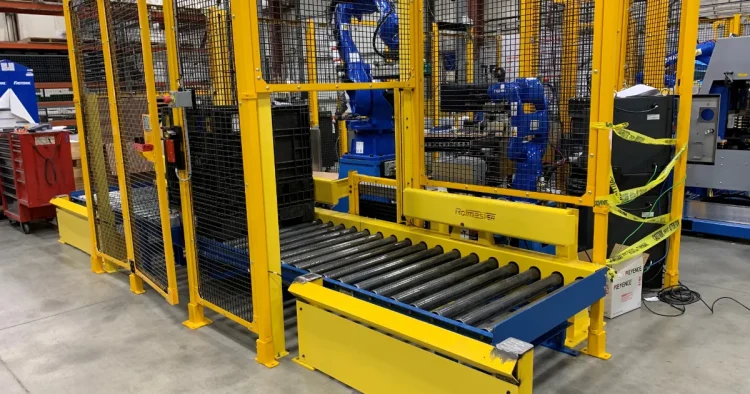
CDLR systems remain the gold standard for true heavy-duty applications. They use a chain running beneath the rollers to provide positive drive power to each roller through attached sprockets. This creates several advantages:
- Handles weights up to 3,000 pounds with proper configuration.
- Maintains consistent movement with minimal slippage even under extreme weight.
- Creates a positive drive that prevents product drift or misalignment.
- Offers exceptional durability with straightforward maintenance requirements.
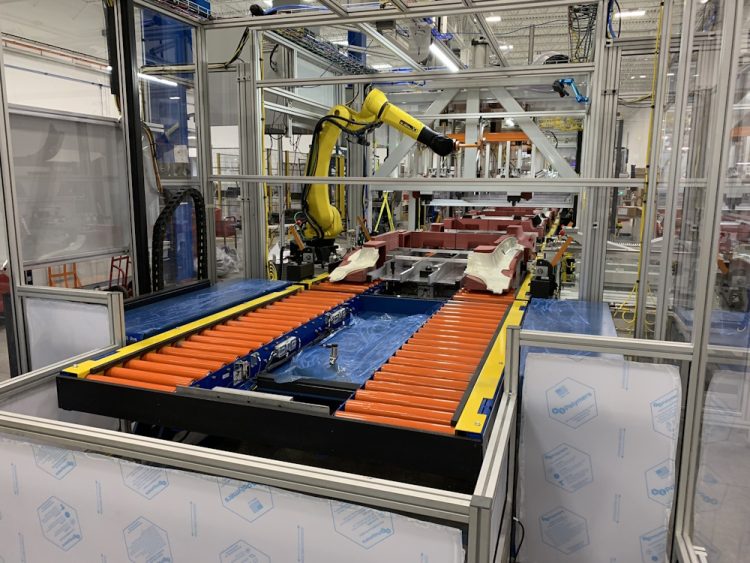
The robust design of CDLR conveyors makes them particularly well-suited for automotive manufacturing and heavy industrial applications. Our case studies demonstrate this capability through real-world implementations. In the Automotive Bin Transfer project, CDLR conveyors with pop-up chain transfers successfully handle bins weighing between 950 and 1,859 pounds with a maximum system capacity of 3,000 pounds.
Slat Conveyor Systems: For Specialized Heavy Applications
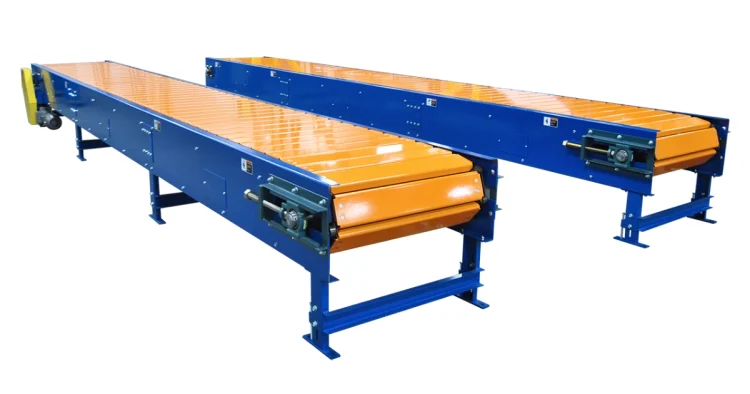
While less common than CDLR, slat conveyors offer unique benefits for certain heavy-duty applications:
- Provide a solid, continuous conveying surface for loads with irregular bottoms.
- Allow for custom fixtures and attachments to be bolted directly to slats.
- Deliver positive chain drive for precise indexing and positioning.
- Maintain excellent durability for long-term production use.
Manufacturing operations that require fixture mounting or specialized product handling often find slat systems provide the best combination of weight capacity and functional flexibility.
When MDR Makes Sense for Material Handling Applications
Motorized Driven Roller (MDR) systems are becoming an industry standard for warehouses, distribution centers, and specialized applications. While not typically the first choice for the heaviest applications, modern MDR technology offers several distinct advantages:
- Zone-based design provides precise product control and accumulation.
- Energy consumption drops significantly by operating only when needed.
- Each zone can be controlled individually or in groups for flexible operation.
- Networked controllers via Ethernet create fully integrated, responsive systems.
Rolmaster offers two MDR variations: O-Ring MDR conveyors for light to medium loads and Poly-V MDR conveyors designed for medium to heavy-duty applications with superior torque transmission.
For distribution centers handling mixed products or automotive operations moving components like battery trays, MDR provides an excellent balance of control and efficiency. The zoned approach allows for varying speeds in different sections—a significant advantage when connecting with other production equipment.
Critical Design Features That Determine Performance
Beyond the basic technology type, specific design elements separate conveyors that merely carry weight from those that deliver true heavy-duty performance.
Roller Specifications: The Foundation of Load Capacity
The rollers themselves are perhaps the most critical component in any heavy-duty system. Key specifications include:
- Tube diameter: Heavy-duty applications typically require 2-1/2″ to 3-1/2″ diameter tubes.
- Tube wall thickness: Thicker walls provide better weight distribution and durability.
- Shaft diameter: Larger shafts (often 11/16″ Hex or 1-1/16″ Hex) prevent bending under load.
- Bearing selection: Quality bearings with proper sealing prevent premature failure.
- Material grade: Higher-grade steel handles impact and prevents deformation.
These specifications matter more than marketing claims. A conveyor rated for 1,000 pounds using undersized rollers will quickly develop problems under daily use, while properly specified components maintain performance over years of service.
Frame and Support Construction: The Overlooked Essential
Even the best rollers will fail if mounted in an inadequate frame. Heavy-duty frames require:
- Deeper side frames with thicker gauge steel.
- Proper cross-bracing to prevent twisting under load.
- Heavy-duty supports rated for 3,000+ pounds.
- Adequate leg spacing to distribute floor loading.
- Proper leveling capabilities to maintain alignment.
When evaluating support structures, check the weight rating for your maximum expected loads plus a safety factor. Heavy-duty supports typically provide a 3,000-pound capacity, compared to the 1,500 pounds offered by standard supports.
Drive System Sizing: Matching Power to Requirements
Underpowered drives are a common failure point in heavy-duty applications. Proper drive sizing considers:
- Total operational weight (product plus conveyor components)
- Required speed (FPM)
- Duty cycle (continuous vs. intermittent operation)
- Starting torque requirements (especially important for fully loaded startup)
- Environmental factors (temperature, dust, moisture)
For CDLR systems, the chain selection and sprocket specifications must match your application’s requirements, with heavier applications requiring more robust chain options for durability.
Engineering for Your Specific Environment
Heavy-duty conveyors don’t operate in isolation. Their performance depends on matching the system to your specific environmental challenges.
Temperature Considerations
Operating environment significantly impacts conveyor performance, particularly at temperature extremes:
- High-temperature environments require special bearing lubricants and material selections.
- Cold environments may need different drive systems and component specifications.
- Temperature fluctuations create expansion/contraction challenges for alignment.
One custom system designed for a Canadian ceramic manufacturer demonstrates this principle. The 1,000-foot line shaft system moved 15-pound ceramic bats through a high-temperature treatment process followed by a cooling zone. The system required materials selected to handle these temperature variations while maintaining precise product handling.
Integration with Existing Systems
Heavy-duty conveyors often need to integrate with other equipment, including:
- Robotic work cells requiring precise positioning.
- Existing material handling systems.
- Manual workstations.
- Quality inspection points.
Proper integration requires detailed planning to match the conveyor’s speed, height, and transfer capabilities with these connection points. Modular designs with adjustable heights and speeds provide the flexibility needed for complex integration projects.
The Canadian Advantage for Heavy-Duty Applications
When sourcing heavy-duty conveyor systems, working with Canadian manufacturers offers several specific advantages:
- Systems built to CSA, provincial OHSA, and CEMA standards from the start.
- Design expertise based on experience with Canadian industrial environments.
- Face-to-face consultation for complex application challenges.
- Faster response times for modifications or support.
- No cross-border shipping delays or compliance issues.
These advantages become particularly important for custom, heavy-duty applications where standard solutions are insufficient. The ability to have engineers visit your facility to understand the specific challenges creates better solutions.
Making the Strategic Investment Decision
Investing in a heavy-duty conveyor system requires striking a balance between upfront costs and long-term operational benefits. Key factors include:
- Total Cost of Ownership: Factor in energy usage, maintenance requirements, expected service life, and potential downtime costs.
- Future Capacity Needs: Size your system for where your business is headed, not just current requirements.
- Integration Flexibility: Choose systems that can adapt as your operations evolve and new equipment is added.
- Support Infrastructure: Consider the availability of parts, technical expertise, and manufacturer support over the system’s lifecycle.
When evaluating bids, look beyond the initial price to the specifications that define true heavy-duty performance. The system with slightly higher upfront costs but properly sized components will typically deliver lower total ownership costs over its service life.
Moving Forward: The First Step Toward Better Heavy-Duty Handling
Identifying the right heavy-duty conveyor solution starts with a comprehensive evaluation of your needs. Begin by documenting:
- Maximum and typical load weights.
- Product dimensions and characteristics.
- Required throughput rates.
- Environmental conditions.
- Integration requirements.
- Future growth projections.
With this information, you can work with experienced conveyor engineers to develop a solution matched to your requirements. The most successful projects begin with this collaborative approach rather than simply ordering a system based on basic specifications.
After 75+ years of designing and manufacturing conveyor systems for demanding applications across Canada, we’ve learned that true heavy-duty performance comes from matching the right technology to your specific application. The right system doesn’t just move your product—it becomes a reliable foundation for your operation’s success.
Ready to explore heavy-duty conveyor options tailored to your specific challenges? Connect with our technical team to discuss your application requirements and discover solutions built for the demands of Canadian industrial environments.