Repetitive lifting injuries don’t show up in incident reports until someone files a workers’ compensation claim. By then, your facility has spent months with workers manually moving materials that modern automated conveyor systems handle automatically.
The actual cost includes lost productivity and medical expenses. Production slowdowns, temporary workers, and overtime to cover injured staff add up faster than the medical bills themselves. Conveyor safety features are a large piece of the puzzle in the work that goes into preventing incidents from occurring in the first place.
When Manual Handling Creates Hidden Injury Costs
Most workplace injuries don’t happen during big equipment failures. They build up slowly through tasks that seem routine. Someone’s back gives out or a shoulder injury needs surgery.
Moving 650-pound pallets by hand creates clear risks. What catches safety staff off guard are the smaller loads. Workers handle these hundreds of times per shift.
Lifting 30-pound boxes repeatedly causes the same damage as rare heavy lifts. The link between daily tasks and injury claims takes months to show up.
Automated conveyor systems eliminate this pattern entirely. MDR conveyors move materials between work areas without manual help. Zone control manages product flow so workers never lift, carry, or move loads.
The Canadian Centre for Occupational Health and Safety identifies work-related musculoskeletal disorders from repetitive tasks as a major source of workplace injuries and associated costs in Canada. Mechanizing repetitive tasks is listed as a primary prevention strategy.
The reduction is most evident in shipping and receiving areas. Workers used to move boxes between trucks and storage. Once conveyors handle transport, injury rates drop within the first three months. Workers’ comp premiums decrease as claim numbers decline.
Conveyors are designed to make material movement easier, faster, and more consistent. In manufacturing plants, warehouses, distribution centres, and processing facilities, they can reduce manual handling and keep products moving efficiently from one operation to the next.
But like any piece of industrial equipment, conveyors also introduce moving components, transfer points, and other areas that need to be treated with care.
Good conveyor safety isn’t based on one guard, one switch, or one procedure. It comes from a combination of proper system design, appropriate guarding, safe operating practices, regular maintenance, and employee awareness.
Start With Safety in the Conveyor Design
Safety should be considered before a conveyor ever reaches the production floor.
The conveyor’s height, location, supports, transfers, drive components, operator stations, and surrounding equipment can all influence how employees interact with the system.
A well-planned conveyor layout should consider questions such as:
- Where will operators normally work?
- Where will maintenance personnel need access?
- Are there moving components near employee work areas?
- Where are the potential pinch or nip points?
- Will employees or vehicles need to travel around or across the conveyor?
- Can the equipment be safely accessed for inspection and service?
Considering these factors during the design stage can help reduce hazards before they become part of the finished installation.
1. Be Aware of Pinch Points
Anywhere two moving components come together — or a moving component approaches a stationary surface — there may be a potential pinch or nip point.
Depending on the conveyor design, these areas can occur around rollers, belts, chains, sprockets, pulleys, transfers, and drive assemblies.
Operators should avoid placing their hands, clothing, tools, or other objects near moving conveyor components. Appropriate guarding should also be incorporated wherever required to prevent unintended access to hazardous areas.
Even gravity conveyor deserves attention. Although it may not contain a powered drive, products and rollers can still move, and hands or fingers can potentially be caught between products, rollers, or adjoining equipment.
2. Keep Guards in Place
Machine guarding is an important part of conveyor safety.
Guards and covers may be used to restrict access to chains, sprockets, drive components, and other moving parts. They should remain properly installed whenever the conveyor is operating.
Removing a guard because it makes a component easier to reach can expose employees to a hazard that the guard was specifically intended to control.
If guarding needs to be removed for maintenance, the conveyor should be properly shut down and isolated according to the facility’s applicable lockout procedures before work begins.
3. Never Reach Into a Running Conveyor
A jammed carton, misaligned product, or dropped object can create a temptation to quickly reach into a conveyor system.
That shortcut can be dangerous.
Employees should never reach into moving conveyor equipment or attempt to manually clear a jam while the equipment is operating. A conveyor can restart unexpectedly, a product can shift, or stored mechanical energy can cause components to move.
Instead, facilities should have an established procedure for safely stopping, isolating, and clearing conveyor jams.
4. Use Proper Lockout Procedures During Maintenance
Conveyor maintenance often requires employees to work close to rollers, chains, drives, motors, and other moving components.
Simply pressing a stop button may not be enough to make the equipment safe to work on.
Before servicing, cleaning, adjusting, or entering a hazardous area of a conveyor system, workers should follow their facility’s established lockout/tagout or energy-isolation procedures. This can include disconnecting electrical power and addressing other sources of stored or potential energy before work begins.
Only properly trained and authorized personnel should perform tasks that require lockout or equipment servicing.
5. Keep the Conveyor Area Clear
The area around the conveyor matters almost as much as the conveyor itself.
Boxes, pallets, tools, cords, packaging materials, and other debris can create trip hazards or make it difficult to access controls and maintenance areas.
Maintaining good housekeeping around the conveyor helps provide employees with clear walking and working areas while also making it easier to identify unusual conditions around the equipment.
Conveyor layouts should also preserve reasonable operator and maintenance access rather than packing equipment so tightly that personnel are forced into unsafe working positions.
6. Don’t Climb, Sit, Stand, or Ride on Conveyors
Unless a system has been specifically engineered for personnel transport, conveyors are material-handling equipment — not walking platforms or rides.
Employees should not climb onto, sit on, stand on, walk across, or ride conveyor equipment.
Where personnel need to cross a conveyor line, the system and facility layout should incorporate an appropriate designated crossing solution rather than encouraging employees to climb over or underneath the equipment.
7. Pay Attention to Loads and Product Behaviour
A conveyor system should be selected and configured for the products it is expected to handle.
Product size, shape, weight, centre of gravity, orientation, and packaging can all influence how a load behaves while travelling along the conveyor.
An unstable or unsuitable load may tip, shift, become caught at a transfer, or fall from the conveyor.
Proper conveyor width, roller or wheel spacing, guides, transfers, and supporting structure can all contribute to more predictable product movement.
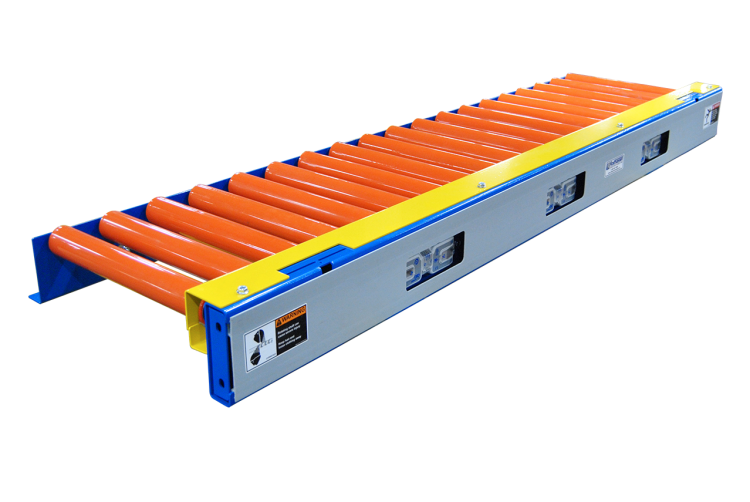
For example, Rolmaster conveyor products are offered in different widths, lengths, and roller-centre configurations so the equipment can be matched to the intended application rather than relying on a single standard configuration.
8. Inspect and Maintain the System Regularly
A conveyor that operates reliably is also easier to operate safely.
Regular inspection can help identify issues such as loose fasteners, damaged guards, worn components, abnormal noises, misalignment, damaged rollers, or other conditions before they become larger problems.
Maintenance requirements will vary by conveyor type and application. Rolmaster gravity conveyor materials, for example, include configurations using oiled, non-precision bearings and steel frames, reinforcing the importance of understanding the components and maintenance requirements of the specific conveyor being used.
Maintenance should always be performed according to the applicable procedures for the specific equipment.
9. Make Emergency Controls Easy to Understand and Access
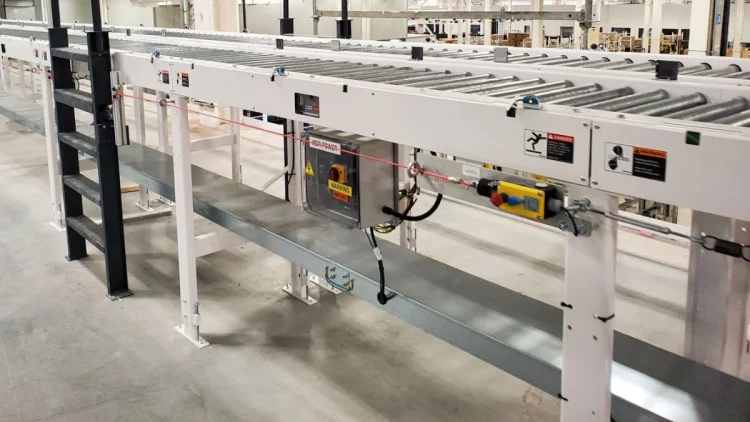
Powered conveyor systems should incorporate the appropriate stopping and emergency-control arrangements for the application and applicable requirements.
Employees working around the equipment should know:
- Where conveyor stop controls are located
- How to stop the system in an emergency
- Which areas of the conveyor a control affects
- What to do after an emergency stop has been activated
- Who is authorized to restart the equipment
Emergency controls are most effective when employees know how and when to use them.
10. Training Is Part of the Safety System
Even a well-designed heavy-duty conveyor, or automatically running MDR conveyors can’t compensate for inadequate training.
Employees who work around conveyor equipment should understand the hazards associated with the system and the procedures that apply to their role.
Training should address normal operation as well as unusual situations such as jams, damaged products, maintenance activity, or emergency shutdowns.
Operators should also be encouraged to report damaged guards, unusual noises, loose components, or other concerns rather than continuing to operate equipment that may require attention.
Safety and Productivity Work Together
Conveyor safety isn’t separate from productivity.
A system that is properly designed, correctly applied, accessible for maintenance, and operated by trained employees is more likely to deliver reliable material flow with fewer interruptions.
Rolmaster conveyor designs use durable steel construction and are available in configurations that can be adapted to different material-handling applications. But regardless of conveyor type, safe operation ultimately depends on how the complete system is designed, installed, guarded, maintained, and used.
When safety is considered from the beginning, it becomes part of the conveyor system rather than something added afterward.
A conveyor’s job is to keep products moving. A good conveyor design also helps make sure the people working around it can do their jobs safely.
Pinch Points That Old Systems Create
Older conveyor designs expose workers to risks that newer systems avoid through better design. Chain-driven systems create pinch points wherever chains meet sprockets. Workers reaching into conveyor lines to clear jams risk finger and hand injuries.
Heavy-duty conveyor systems with enclosed drive parts prevent contact with moving pieces entirely. Standard roller configurations work for light applications. Facilities moving pallets above 1,000 pounds need heavy-duty conveyor selection based on actual load requirements, not theoretical capacity.
CDLR conveyors enclose chain drives behind removable guards. Maintenance teams access internal parts only after completing the lockout steps, which stop all motion.
Pop-up transfers lift and lower through fixed chains. Workers don’t manually redirect products across transfer points.
Temperature swings between loading docks and production floors create extra risks. Better design fixes these. Ontario facilities see 40-degree temperature changes between -20°C docks and +20°C work areas.
Bearing failures happen more often when oil breaks down under heat stress. Properly chosen bearings work well across temperature ranges. This cuts unexpected stops that force workers to step in manually during production runs.
How Zone Control Prevents Crash Injuries
Production lines moving at 140 feet per minute pose a crash risk. Workers step into conveyor paths or equipment breaks. Products get sent into areas where people are working.
Old systems rely on emergency stops that workers must press manually. Reaction time decides whether someone gets hurt.
Zone control systems, often MDR conveyors, automatically stop conveyor sections when sensors detect blocks. Each zone works alone. Nearby sections keep running while the affected area stays stopped.
Workers can fix issues in one zone without shutting down whole production lines. Sensor links and other conveyor safety features prevent restarts until the block clears fully.
The technology matters most in auto facilities. Robots and conveyor systems work close together there. Automated conveyor systems coordinate timing through sensor integration that manual controls can’t match.
Timed coordination between automated conveyor systems and robots requires sensor-to-sensor communication measured in thousandths of a second. Zone control makes sure that product positioning matches robot cycle times. This prevents situations where workers enter active zones during automated work.
Ergonomic Improvements That Cut Strain
Work area height decides whether workers spend shifts in good positions or develop chronic pain from bad postures. Gravity conveyors set at the wrong heights force workers to bend, reach, or twist repeatedly. The effect shows up as back injuries and shoulder problems.
Adjustable conveyor supports let facilities optimize heights for specific tasks and worker groups. Heavy-duty conveyor supports handle loads up to 3,000 pounds. They give height adjustment ranges from 11.25 inches to 72 inches.
Facilities can set up work areas so products arrive at good handling heights. Workers don’t need to lift or lower materials and can utilize conveyor safety features such as lift assists and specialized loading/unloading zones.
Ball transfer systems at work area ends let workers rotate products by hand without lifting. Parts arrive on conveyors. Workers do assembly or inspection tasks. Ball transfers allow repositioning through simple pushing rather than lifting and turning.
WorkSafeBC research on lifting and handling shows that properly set conveyor heights reduce injury claims. It also improves productivity through reduced worker fatigue.
When Equipment Reliability Becomes a Safety Issue
Bearing failures create risks beyond noise and production delays. When rollers seize without warning, products jam against stopped rollers. The backup forces workers to enter the conveyor lines to manually clear blocks.
Each manual step creates injury risk and a potential conveyor safety hazard. The frequency of failures directly relates to workers’ exposure to hazards. Automated conveyor systems which have less need for a hands-on approach will reduce these risk points.
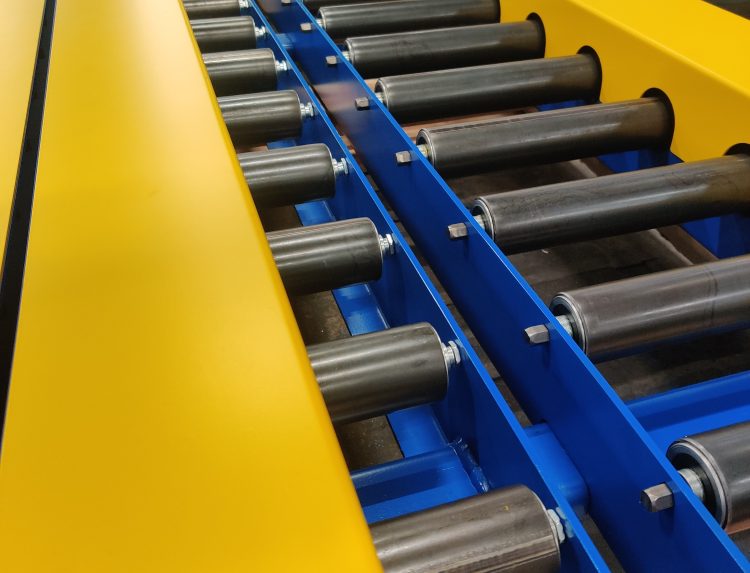
Proper roller specs prevent most failures before they occur. Light-duty rollers rated for 182 pounds fail quickly under heavier loads. Upgrading to medium-duty rollers rated for 770 pounds eliminates early bearing wear. Utilizing heavy-duty conveyors where required is always preferable to trying to overload a light-duty conveyor for the sake of cost.
The capacity gap seems clear. Many facilities work with undersized rollers installed during initial setup. Replacement cycles never fix the underlying spec problem. Measuring replacement conveyor rollers correctly prevents ordering mistakes that perpetuate undersized specifications.
Canadian facilities face maintenance challenges that offshore makers don’t account for in standard specs. Temperature swings affect bearing oil more than most suppliers realize. Facilities near Cambridge are seeing conditions that require cold-weather bearing specs. Miss those needs and you’re replacing bearings every six months instead of every three years. Over time, this can impact conveyor safety.
Conveyor Safety Features That Modern Systems Include
Sensor links coordinate work between conveyor sections. They prevent the timing mismatches that create hazards.
When upstream conveyors deliver products faster than downstream sections can accept them, products pile up at transfer points. Something jams or falls. Zone control and MDR conveyors manage product flow autonomously. It keeps proper spacing without needing workers to manually regulate feed rates.
Emergency stops stay within reach, but work differently in modern systems. Rather than killing power to entire lines, zone-specific stops halt power to affected sections. Other areas finish current cycles safely. This is especially prevalent with MDR conveyors, as only the needed zones are running at any given moment.
Workers can fix problems without creating extra hazards from sudden equipment stops. Production teams can restart individual zones without going through full system startup steps.
Guardrails and side guides prevent products from leaving the conveyor path. Proper installation prevents most manual handling during normal work. When products do need manual assistance, work area design ensures workers can reach the items. They don’t enter active conveyor zones or adopt awkward postures that increase injury risk.
Compliance Rules That Conveyors Must Meet
CSA standards specify mechanical safeguards, electrical needs, and operational controls that conveyor systems must include. Facilities working in Ontario need CSA-compliant equipment. Provincial OHSA rules enforce specific needs for machine guarding, emergency stops, and worker training on equipment use.
Conveyor safety features that meet current standards include enclosed drive parts. Accessible emergency stops at regular intervals are required. Clear marking of hazard zones where workers should not enter during operation is mandatory.
Facilities upgrading older systems often discover that legacy equipment lacks guards or conveyor safety controls required by current rules. Bringing systems into compliance needs more than adding bolt-on safety features.
CEMA standards give technical specs for conveyor design and manufacture. They cover load ratings, structural needs, and testing steps. Equipment built to CEMA standards performs as expected under specified loads.
Facilities can rely on capacity ratings without conducting independent testing. Our Cambridge facility makes systems in line with CEMA standards. That compliance extends through design, building, and testing before equipment ships. Ensuring you are using heavy-duty conveyors where appropriate is a huge step towards less breakdowns and fewer injury risks.
What Facilities Gain Beyond Injury Reduction
Lower workers’ comp premiums follow reduced injury rates. Safety improvements, specifically conveyor safety features, deliver extra benefits that affect operating costs. Automated material handling reduces staffing needs for transport tasks. Facilities redirect labor toward higher-value work rather than simply moving materials between locations.
Production consistency improves when conveyors eliminate the variables introduced by manual handling. Workers move materials at different speeds depending on fatigue, attention, and experience level. Conveyor systems keep constant throughput regardless of shift changes or individual capabilities.
Consistency matters most in facilities where downstream processes depend on a steady material supply. Variations in feed rates create quality problems or equipment idle time.
Fewer manual steps mean fewer chances for products to get damaged during handling. Automated conveyor systems move materials along set paths. No drops, bumps, or improper placement occur during manual transport. Reduced damage rates improve material use while cutting rework costs.
Making the Transition Without Disrupting Production
Replacing conveyor systems during full production shutdowns isn’t realistic for most facilities. Manufacturing schedules don’t allow weeks-long equipment installations. Phased approaches let facilities upgrade dated sections while keeping operations running in other areas.
The strategy starts with identifying sections where manual handling creates the highest injury risk. Look for where equipment failures happen most often.
Targeting those areas first delivers immediate safety improvements. It gives time to plan later phases. Each finished section shows benefits that justify continued investment. Production teams develop familiarity with new systems before facility-wide implementation.
Coordination between existing infrastructure and new equipment needs attention at transfer points. This is where products move between old and new sections. Height mismatches, speed differences, or control integration gaps create new problems. Installation teams must address compatibility during the design phase.
Working with technical account executives or customer service representatives from Rolmaster who understand both your existing system and new equipment specs prevents issues. These become expensive to fix after installation, not to mention could result in conveyor safety issues.
Contact us to assess your current system, identify sections where upgrades deliver the greatest conveyor safety improvements, and coordinate installation timing that works within your production schedule.