
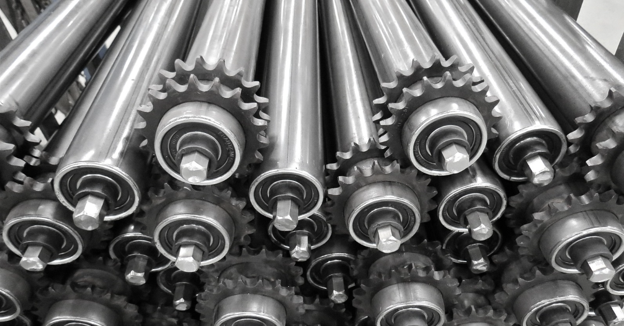
Rollers earn their rating at the point of contact, and that’s where the work concentrates. On a busy line, the transfer points take the impact each time a load crosses between sections. The types of conveyor rollers that hold up there get specced for the transfer, not only the steady run.
Where loads land and hand off, a roller meets different demands than it does mid-run. Bearing and axle selections have to handle repeated impact.
Conveyor rollers may look like relatively simple components, but they have a major influence on how reliably a conveyor system performs. The right roller can provide years of dependable service, while a roller that is poorly matched to the application can contribute to excessive noise, premature bearing wear, product damage, and unnecessary downtime.
What Separates the Types of Conveyor Rollers
A duty label is shorthand for three specs working together:
- Tube diameter sets how much the roller deflects under load.
- The axle holds it true in the frame.
- Bearing type governs behaviour at speed and in temperature swings.
The conveyor roller load rating on the specification sheet is the output of those three, not the input. That’s why CEMA rates roller capacity on calculated bearing life at a given load and speed, not a headline weight. Two rollers of the same diameter can carry loads that differ by hundreds of pounds across a full shift, and can function as either light-duty or heavy duty conveyor rollers.
Wall thickness works with diameter to set that deflection. A thicker tube on a larger diameter resists sag between supports, which matters as roller spacing widens under longer packages. Spacing follows a simple discipline. At least three rollers always sit under the smallest load, so nothing drops into a gap.
Bearing construction sits underneath every capacity figure. A precision ball bearing in a machined housing turns with less resistance and holds alignment tighter than a stamped-race equivalent. Lubrication packed for the operating temperature keeps that resistance stable through a full production cycle. The configuration a facility chooses determines how the published capacity behaves once the line runs loaded and continuous.
Rolmaster builds across the range for this reason. Light duty carries up to 182 lbs, medium duty up to 770 lbs, and heavy duty up to 1000 lbs. Poly-V, tapered, and sprocket rollers cover the applications those three bands don’t.
The bands overlap, so a medium-duty roller and a heavy-duty one can both suit a 700-pound load. The right selection depends on how often that load lands and how fast the line operates. Failing to calculate this correctly can lead to requiring more frequent replacement conveyor rollers.
Gravity Conveyor Rollers
Gravity rollers are among the most widely used conveyor rollers in industrial material handling. Instead of being individually powered, these rollers rotate freely as the product moves across the conveyor.
Gravity conveyor rollers can be used on level conveyors where products are moved manually or on slightly declined conveyor sections where gravity provides the force required to move the load.
They are commonly found in warehouses, shipping and receiving areas, assembly operations, order-picking systems, and manufacturing facilities. Depending on the construction of the roller, gravity systems can handle everything from small cartons and totes to considerably heavier products.
Roller diameter, wall thickness, axle size, bearing selection, and roller spacing all influence the capacity of the conveyor. This makes conveyor roller load rating an important consideration even for seemingly simple gravity applications. Gravity conveyors come in just about every size you can imagine, so there will be a roller available for every use case.
Powered Conveyor Rollers
Powered roller conveyors use a drive system to move products without requiring an operator or gravity to provide the conveying force. Depending on the conveyor design, power may be transferred between rollers using chains, belts, O-rings, or other drive components.
One common example is chain-driven live roller conveyor, often referred to as CDLR. These systems are commonly used for heavier unit loads such as pallets, drums, containers, and manufactured components.
Powered rollers typically experience additional forces that are not present in basic gravity applications. The roller must support the product while also transmitting the force required to move it. This can influence the required tube construction, bearing capacity, axle design, and drive components.
For heavier applications, heavy duty conveyor rollers may use larger diameters, thicker tube walls, stronger bearings, and more substantial axle assemblies to withstand both the product load and the forces generated by the drive system.
Motorized Roller and MDR Systems
Motor-driven roller, or MDR, conveyors take a different approach to powered conveying. Instead of relying on one centralized drive to power a long conveyor section, MDR systems typically use motorized rollers to power individual zones.
These zones can operate independently, allowing products to accumulate without constantly contacting or pushing against one another. This makes MDR technology particularly useful for cartons, totes, packages, and products that benefit from controlled accumulation.
Because only the required zones need to run, MDR systems can also reduce unnecessary conveyor operation during periods when there is no product in a particular section. This can cut down on overall usage significantly, and will almost certainly result in less frequent need for conveyor replacement rollers.
Roller selection remains important in these systems. The motorized roller itself must be properly specified, while the accompanying idler rollers need to provide the required support and operate with minimal resistance.
Stainless Steel Conveyor Rollers
Stainless steel rollers are typically selected where corrosion resistance, sanitation, or frequent washdown is important.
Food processing, pharmaceutical manufacturing, chemical environments, and other applications involving moisture or corrosive materials may benefit from stainless steel construction. While stainless rollers can be more expensive than conventional carbon steel rollers, their resistance to corrosion can provide a significant advantage in environments where ordinary steel would deteriorate quickly.
The bearings, seals, axle, and other roller components should also be considered. Installing a corrosion-resistant tube does little good if other critical components cannot withstand the operating environment.
PVC and Polymer Rollers
Not every industrial application requires a steel roller. PVC and other polymer rollers can be suitable for lightweight applications where low weight, corrosion resistance, or reduced operating noise is desirable.
These rollers may be found in applications involving lightweight cartons, packaging, and certain washdown or corrosive environments.
Their limitations should also be understood. Plastic rollers generally cannot match the load capacity or impact resistance of heavy duty conveyor rollers designed for demanding industrial service.
Temperature can also be a factor because some plastics may soften, become brittle, or change their mechanical properties when exposed to conditions outside their intended operating range.
Coated and Sleeved Conveyor Rollers
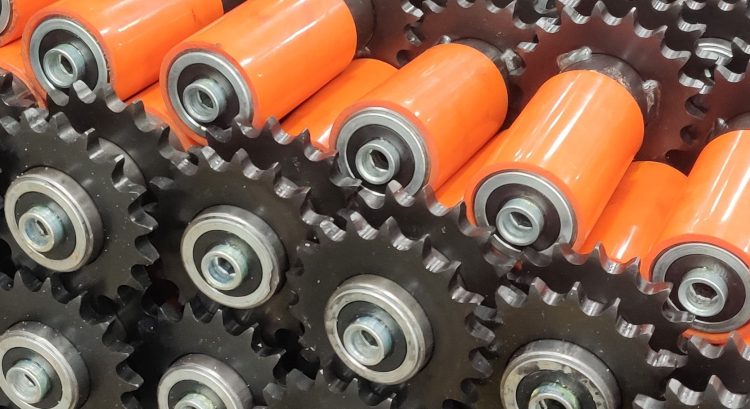
Sometimes the product requires a surface that is different from the underlying roller material. In these situations, conveyor rollers can be coated or fitted with sleeves.
Common materials include polyurethane, rubber, PVC, and other elastomers or polymers. These surfaces may provide additional grip, reduce noise, protect delicate products, or prevent metal-to-metal contact. The added protection can also help reduce the need for frequent replacement conveyor rollers.
Coated rollers can be particularly useful when conveying finished products where scratches or surface damage would be unacceptable, such as in delicate or expensive consumer products.
The coating itself must be matched to the application. Its hardness, thickness, chemical resistance, temperature resistance, and expected wear rate should all be considered.
Grooved and Sprocketed Rollers
Some rollers are manufactured specifically to interact with the conveyor’s drive system.
Grooved rollers can accept O-rings or belts that transfer power from one roller to another. Sprocketed rollers are commonly found in chain-driven conveyor systems, where sprockets mounted to the rollers engage with the drive chain.
These components experience both load and drive forces, making proper alignment especially important. Excessive chain tension, poor sprocket alignment, or incorrect installation can increase the forces transmitted into the bearings and contribute to premature wear, possibly even leading to requiring replacement conveyor rollers.
Understanding Conveyor Roller Load Rating
One of the most important factors in roller selection is conveyor roller load rating. It is tempting to simply divide the total product weight by the number of rollers underneath it, but actual conveyor loading can be more complicated.
Products rarely distribute their weight perfectly across every roller. Uneven product bottoms, concentrated loads, conveyor transitions, loading impacts, and changes in roller spacing can cause individual rollers to carry more weight than expected.
The roller tube itself is only one part of the equation. Bearing capacity, axle strength, axle deflection, mounting method, and the distance between the conveyor frames can all influence the practical capacity of the roller.
Applications involving significant impact should receive particular attention. Dropping a heavy product onto a conveyor can generate forces considerably higher than its static weight.
For this reason, conveyor roller load rating should be evaluated against the actual operating conditions rather than product weight alone.
When Package Lines Move Light Loads Fast
Most distribution work runs on light and medium-duty rollers moving cartons, totes, and small parcels. Speed matters more than raw capacity here, so bearing choice and diameter get set for smooth running at pace. Get the diameter and spacing right, and boxes stay square through fast merges.
On a belt-driven roller line, the belt doesn’t carry the box. It drives the rollers, and the rollers move the load. A break in that belt-to-roller handoff stops the section. That makes bearing drag a throughput question, not only a maintenance one.
Accumulation is where distribution rollers earn their spacing. When product backs up behind a stop, the rollers underneath keep spinning while the load sits still. The bearing sees continuous rotation against a stationary weight.
One distribution upgrade replaced an ageing line shaft with O-Ring motor-driven rollers rated to 50 lbs per foot. They held accumulation zone by zone, without one shaft driving the whole run. Continuous rotation against a held load is a harder duty on the bearing than moving product straight through.
Curves add their own demand. A straight roller moves both edges of a load at the same speed, so packages skew through the curve. Tapered rollers answer this with a larger diameter on the outside, speeding the outer edge so the load stays square.
Manufacturing lines rely on the same medium-duty rollers for work-in-process and lighter parts between stations. The conveyor rollers for material handling here run for hours without a stop. Lubrication and seal choice decide how long they hold. A pre-lubricated sealed bearing keeps package and parts lines moving without a standing maintenance draw, and lowers the risk of a conveyor roller bearing failure.
When Heavy Loads Demand More from the Roller
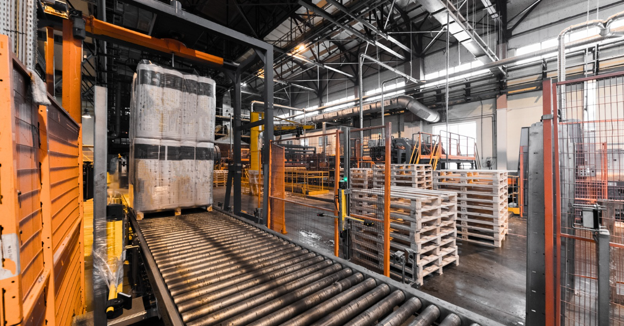
Pallets and heavy assemblies change the equation. A 650-pound automotive pallet concentrates its weight on a short run of rollers at every transfer. Heavy-duty conveyor rollers answer this with larger diameters, thicker walls, and bearings built for impact loading. A pallet dropping onto the rollers hits harder than one that rolls on, and the bearing registers that difference first.
Axle size scales with the load the same way. Heavier capacities move to larger axle diameters and, where the application needs it, precision bearings that hold tolerances at speed. A precision roller runs quieter and truer under an indexing pallet, which is the repeatable positioning an automated cell needs.
The heaviest jobs push past a single roller and into system design. A CDLR line handling 3,000-pound steel pallets carries the load on heavy duty conveyor rollers driven by sprockets. The drive and the roller get specced as one. Picking the roller here sits inside a larger set of choices we cover in our heavy-duty conveyor selection guide.
Some automotive jobs run heavier still. A CDLR line moving bins from 950 to 1,859 lbs uses pop-up chain transfers to lift and shift them. The heavy duty conveyor rollers underneath get sized for the system max, not the lightest bin. Speccing for the heaviest load the line will ever see protects the bearing’s calculated life across the whole mix and avoids frequent need for replacement conveyor rollers.
When the Roller Has to Be Driven
Gravity lines let the roller spin free, so tube and bearing carry the whole story. Powered lines ask the roller to take drive as well as load, and that second demand changes the roller’s construction. This can narrow down the types of conveyor rollers that may suit your application, and avoid the need for frequent replacement conveyor rollers.
Poly-V rollers carry grooves that grip a ribbed drive band, keeping the roller turning without slip. Sprocketed heavy duty conveyor rollers take a chain instead, which suits the positive drive heavy pallets need. On a driven line, worn drive grooves or a loose chain show up as product that lags behind its timing.
Drive band choice splits the light-duty powered lines too. O-Ring drives loop around grooved spools between rollers, an economical pattern for lighter accumulation. Poly-V bands carry more torque across the same footprint, which suits heavier package rates and tighter zone timing. The groove profile has to match the band, so the drive holds torque to the roller’s rated load.
On 24-volt motor-driven roller systems, the driven roller becomes the motor’s output. Zone control depends on each one turning true. A twin-run motor-driven roller line shows what tight drive matching buys. It indexed 650-pound automotive pallets at 140 feet per minute through a turntable, holding position across every transfer.
When Heat and Cold Reach the Bearing
Bearing and seal choice carry the environmental demands more than tube size does. Canadian plants swing from -30°C at a receiving door to shop-floor heat, fighting grease rated for milder conditions. A low-temperature synthetic lubricant keeps its viscosity where petroleum grease stiffens, protecting the bearing through the coldest morning startups.
Heat treatment lines push the far end of that range. One ceramic handling system ran 1,000 feet of line shaft through a heat-treatment process in lights-out production. It moved 14-inch bats at temperatures well beyond what standard grease tolerates. High-temperature bearings and urethane band pop-up transfers kept that line running through the full heat cycle.
Speed pushes the bearing in the opposite direction. A roller turning fast on a high-throughput line generates heat at the bearing, and undersized bearings wear early under it. Conveyor roller bearing failure gives warning before it stops a line. Bearings grind before they seize, so catching that sound early means replacing a bearing, not the product too.
Dust and moisture add a sealing question on top. A sealed bearing keeps grit and water off the rolling elements. That lets a roller hold its rating in a dirty bay instead of chewing through bearings and suffering from early conveyor roller bearing failure.
A double lip contact seal resists water better than a metal shield, which suits wash-down packaging bays. The trade runs a little more rotational drag for a lot more contamination protection.
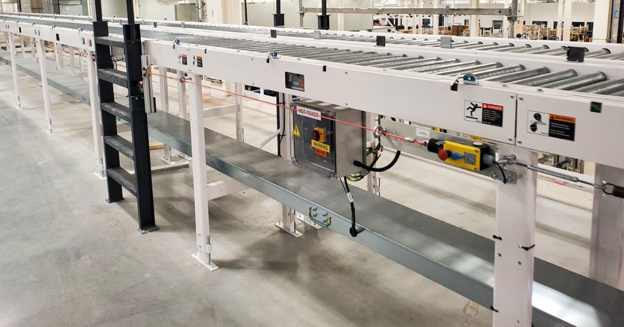
Canadian safety guidance calls for guarding the pinch points on rollers, wheels, and drive systems. That extends to every point where loads transfer between sections. Speccing to the real load, not past it, keeps the line inside both its safety case and its bearing life.
Matching Replacement Rollers to the Frame
A replacement is where all of this meets a frame that already exists. Replacement conveyor rollers have to match the tube diameter, axle size, conveyor roller load rating, and bearing bore of what came out. Miss any of those and the roller runs rough and wears early, potentially even suffering a conveyor roller bearing failure.
The measurements that matter are the ones a calliper confirms. Tube inner diameter sets the bearing’s outer fit, and shaft diameter sets the bore. Between-frame length has to land within the existing rails. Matching all three to the original keeps the replacement running true from the first production shift.
Reading the old roller’s markings identifies most of it. Where the markings have worn off, the replacement roller measurement guide lists the dimensions to confirm.
Across every band, the specs inside the label decide whether the conveyor roller load rating holds on the floor. Early failures at the transfer points often trace back to a roller matched to the label, not the job. Reach out to our Cambridge team to match roller type, bearing, and axle to what your line carries and secure the proper replacement conveyor rollers. We have all types of conveyor rollers to meet your needs, just reach out and ask one of our CSR team members for assistance.