Your new robotic work cell processes parts in under two minutes per cycle. The automotive rack feeding it takes four minutes to position. That gap between what the robot can do and what the conveyor delivers is where automotive throughput gets lost, and it rarely gets specifications during system design.
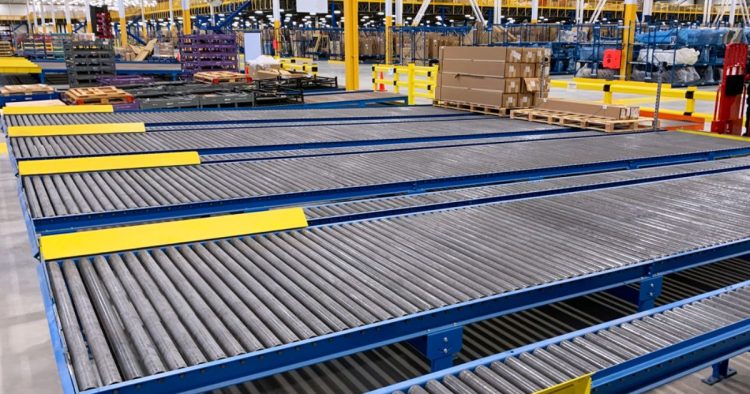
In-and-out conveyor systems close that gap by treating rack movement as part of the automation cycle. A forklift loads the in-feed. The conveyor moves the full rack into the cell, positions it for the robot arm, and holds it through the pick cycle.
When the rack is empty, the system transfers it out to the discharge conveyor for forklift pickup while the next full rack feeds in. No manual repositioning, no operator timing the sequence by hand.
The Canadian Centre for Occupational Health and Safety reports that about three in four Canadians whose jobs include manual materials handling suffer back pain at some point — every forklift extraction-and-reposition cycle the conveyor eliminates is a physical exposure removed from the job.
Gravity or Powered?
One of the major advantages of roller-based rack systems is that they can be configured for either gravity or powered movement.
Gravity roller systems use a slight decline to move products from the loading side toward the unloading side. This can be an extremely effective solution for applications where products naturally need to move in one direction.
Gravity systems require no motor to move the load through the rack, which helps reduce electrical requirements and the number of powered components in the system.
For heavier loads, controlled positioning, or applications where products need to travel horizontally, powered conveyor sections may be more appropriate.
Powered roller or CDLR sections can move pallets and other heavy loads directly into and out of rack positions. Sensors, stops, brakes, and controls can then be incorporated to determine when each load is allowed to move.
The rack effectively becomes an extension of the powered conveyor line.
What the Conveyor Actually Has to Do Inside a Robotic Cell
Positioning accuracy is what the robot depends on. Robotic arms operate within tight reach envelopes, and a rack that arrives two inches off-centre forces the robot to adapt, slow down, or fault out. In high-volume automotive applications, that kind of positioning variance compounds quickly across shifts.
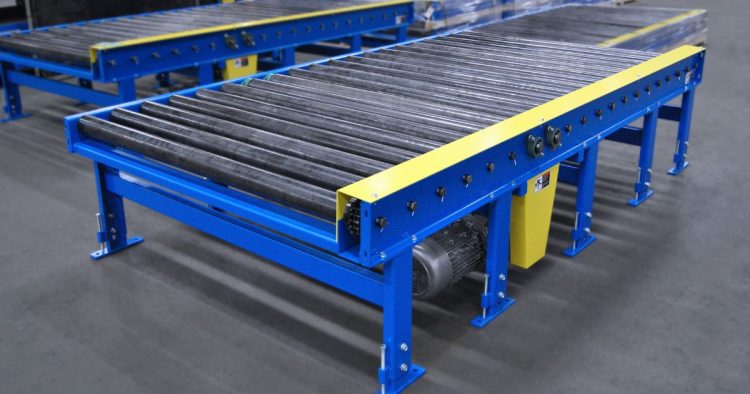
In-and-out conveyor systems for this application combine Chain Driven Live Roller conveyors with pop-up chain transfers. CDLR provides positive drive force under heavy loads through sprocket-connected rollers driven by a single chain. Unlike gravity roller or MDR systems, CDLR maintains consistent drive regardless of load weight, which matters when racks range from 950 lbs empty to 1,859 lbs full.
Heavy-duty pallet guides and forklift stops at each position deliver the same rack placement every cycle, regardless of how the forklift loaded the infeed. Pop-up chain transfers handle directional changes within the cell footprint. When a rack reaches the transfer point, a chain section rises through the roller bed, lifts the rack slightly, and moves it in the new direction.
Once the transfer completes, the chain retracts and the rack settles onto the roller bed in the new orientation. The full sequence takes seconds and runs under PLC control, not operator intervention.
What Is an In-and-Out Rack?
An in-and-out rack is a storage system designed around the controlled movement of products, pallets, totes, containers, or other loads into and out of a storage position.
Unlike traditional static racking, where products are placed on fixed beams or shelves, an in-and-out rack can incorporate conveyor rollers, gravity lanes, powered rollers, chain-driven sections, CDLR conveyors, or other conveying components directly into the rack structure.
This allows a load to move through the rack instead of simply sitting on it.
Depending on the application, products can enter from one side and exit from another, or the same opening can be used for both loading and unloading. The rack can operate manually, through gravity, with powered conveyor equipment, or as part of a larger automated material handling system.
This flexibility makes the concept useful for facilities that want to improve material flow without necessarily replacing their entire storage infrastructure.
Why the Conveyor Gets Underspecced in Robotic Cell Projects
Automotive plants invest carefully in robotic work cells. The robot, end-of-arm tooling, vision system, and controls all get specified in detail. The conveyor feeding the cell often gets treated as a commodity purchase, specced by load capacity alone and sourced separately from the automation integrator. Load capacity is necessary but not sufficient.
The International Federation of Robotics reported 542,000 industrial robot installations globally in 2024, the second-highest annual volume on record. As robotic cell density increases in automotive plants, the conveyors feeding those cells carry more production risk than they used to. A robot that idles between cycles because the conveyor is slow, misaligned, or undersized for the rack weight isn’t returning its investment.
Rack weight, cycle timing, directional changes within the cell, forklift interface at the infeed, and discharge accumulation all affect conveyor configuration. When those decisions happen independently of the robot integrator, the gaps show up during commissioning. Commissioning fixes are expensive in ways that design-phase changes aren’t.
We work directly with integrators on these systems, and the pattern we see most often is a conveyor that was rated for the load but not designed for the cycle. Capacity gets checked. Timing, transfer coordination, and discharge accumulation don’t always make it onto the spec sheet until something goes wrong on-site.
CDLR Specifications for Heavy Automotive Rack Handling
Roller diameter and spacing get selected based on automotive rack base dimensions. For wide racks like the 96.5″ x 69″ configuration in our Automotive Bin Transfer installation, the roller layout needs to support the full rack footprint evenly. CDLR capacity ratings assume distributed load across the roller bed.
When weight concentrates on individual rollers at the rack contact points, underspecified systems fail there first. Our heavy-duty conveyor selection guide covers how to read load distribution specs before locking in a configuration.
Drive chain tension and sprocket sizing get set for the heaviest expected load, but the system also has to handle the empty rack reliably. A 950 lb empty rack on a conveyor tuned for a 1,859 lb full load behaves differently at every stage: stopping distance is shorter, transfer timing is faster, and guide contact pressure changes.
Systems that only get tested at full load produce surprises in production when empty racks cycle through at a different rate. Those surprises usually surface during the first week of operation, when adjusting them requires pulling production time.
Frame height and conveyor width need to match the cell structure and robot reach envelope. Those dimensions are easy to coordinate when the conveyor is in the design conversation early. After the cell is built, changing them is rarely simple and never cheap.
Reducing Forklift Dependency
One of the biggest opportunities for conveyor-integrated storage is reducing the number of times a load needs to be handled by a forklift.
Forklifts remain essential in many facilities, but using them for every movement between storage and production can create congestion and unnecessary handling.
If pallets can move directly from production into a conveyorized storage rack and later return automatically to the conveyor line, several forklift movements can potentially be eliminated.
Forklifts can then focus on the movements where they provide the most value, such as receiving, shipping, bulk storage, and irregular material handling.
Meanwhile, repetitive movements between fixed production and storage locations can be handled by conveyors.
Designing Around the Product
There is no universal in-and-out rack configuration.
A successful system begins with understanding the product.
The designer needs to consider the load’s dimensions, weight, bottom surface, orientation, center of gravity, throughput requirements, accumulation requirements, and how the product will enter and leave the rack.
A wooden pallet may work extremely well on heavy-duty conveyor rollers, while a container with an irregular bottom may require tighter roller centers or a different conveyor surface altogether.
The rack structure, rollers, bearings, drive components, guarding, stops, and controls should all be selected around the actual load and operating environment.
This is one reason custom conveyor design can be so valuable. Rather than forcing the product to work with a standard storage configuration, the conveyor and rack can be engineered around the way the material actually needs to move, and can even utilize conveyor robotic cell integration.
Bridging the Gap
Full warehouse automation does not always happen in a single project.
Many facilities automate gradually, replacing individual manual processes as production requirements, budgets, and layouts evolve.
In-and-out racks fit naturally into this approach because they can connect traditional storage concepts with modern conveyor technology.
A relatively simple gravity roller rack can improve FIFO movement and reduce manual handling. A powered rack can provide automated accumulation and pallet movement. Add sensors and controls, and that same basic concept can become part of a fully automated material handling system.
That scalability is what makes in-and-out racks so useful.
They represent more than storage equipment and more than conveyor equipment. They are the point where the two systems meet—allowing products to transition smoothly between being stored and being moved.
As manufacturers and distribution facilities continue looking for ways to improve material flow, reduce unnecessary handling, and introduce automation without completely redesigning their operations, conveyor-integrated in-and-out racks offer a practical path forward.
Why Rollers Matter
At the heart of many in-and-out rack systems are the rollers.
While rollers may appear to be relatively simple components, their specifications have a major impact on how effectively the rack operates.
Roller diameter, wall thickness, bearing selection, axle configuration, spacing, and overall load capacity all need to match the product being handled. A rack carrying lightweight cartons has very different requirements from one handling 2,000-pound pallets.
Roller spacing is particularly important.
A load must maintain enough points of contact with the conveyor surface to remain stable as it travels through the rack. If rollers are spaced too far apart, smaller loads can become unstable or catch between rollers. If they are spaced unnecessarily close together, the system can become heavier and more expensive without providing a meaningful performance benefit.
Selecting the correct roller arrangement allows the rack to support the load while still providing smooth, predictable movement.
Sensor Placement and PLC Coordination
The conveyor and the robot share the same work envelope during rack handling, so their timing runs through one control system. Sensors at the infeed, the work position, and the discharge point feed rack location data to the PLC.
The PLC triggers CDLR conveyor zones, manages pop-up transfer timing, and signals the robot controller when the rack is confirmed in position and the conveyor mechanism is clear. The robot doesn’t start its pick cycle until the conveyor confirms rack position. The conveyor doesn’t move the rack until the robot confirms it has cleared the work envelope.
That handshake runs continuously through production, and it only works reliably when sensor placement was planned with both the conveyor geometry and the robot arm path in mind. Pop-up transfer timing is where most commissioning time goes on these systems. Activate too early and the rack hasn’t fully cleared the upstream conveyor section. Too late and the rack overruns the transfer point.
Those windows are narrow, and sensor placement drives how consistently they get hit. PLC logic that doesn’t account for the weight difference between a full and empty rack will produce different timing behaviour across the two states, and faults that are slow to diagnose under production pressure.
Read more about how automated conveyor systems coordinate timing and zone control with robotic cells if you’re working through the controls side of a cell design.
Managing the Discharge Side
Empty rack accumulation between robot cycles and forklift pickup is the part of the system that gets undersized most often. The robot cycles faster than forklifts clear the discharge end, so the discharge CDLR conveyor needs to hold multiple empty racks without backing up into the cell.
Short accumulation sections on the discharge CDLR conveyors let the cell keep running while forklifts work on their own schedule. Sizing those sections requires knowing how many robot cycles typically run between forklift pickups, not just the maximum rack dimensions.
A discharge zone sized for two racks on a cell that regularly queues four will create a production stop every time the queue fills. It will fill regularly. Forklift stops at the discharge position keep empty racks from drifting beyond the pickup point.
Without them, racks shift under residual conveyor motion and forklift operators spend time repositioning loads that should be ready to pick. In a cell running multiple shifts, that lost time adds up faster than it looks on a single-cycle basis.
Supporting FIFO Material Flow
Roller racks are particularly well suited to first-in, first-out (FIFO) inventory movement.
In a gravity configuration, products are loaded from one side of the rack and retrieved from the opposite side. The first product loaded naturally becomes the first product available for removal.
This can be useful for materials where inventory rotation matters, but it also provides another important advantage: separation between loading and unloading activities.
Forklifts, operators, or automated equipment replenishing the rack can work from one side while production or outbound material handling equipment retrieves loads from the other. This is also referred to as an in-and-out conveyor system.
That separation can help create a cleaner, more predictable material flow through the facility.
Full and Empty Rack Behaviour Across the Cycle
The weight difference between a full automotive rack at 1,859 lbs and an empty automotive rack at 950 lbs affects how the conveyor performs at every point in the cycle. Drive requirements, stopping distances, transfer timing, and guide contact pressure all shift between the two states. A system designed and tested only at full load will behave predictably with full racks and unpredictably with empty ones.
CDLR conveyors handle this range through drive chain tension settings and roller brake configurations that account for both ends of the weight spectrum. The goal is consistent behaviour across the full cycle, not just at peak load. Getting there requires testing with actual rack weights across both states during commissioning, not just confirming the system moves under load.
This is also where forklift stops earn their place in the design. An empty rack has less inertia and stops faster, which means it can overshoot a lightly tensioned stop if the system was only tuned for the heavier loaded state. Forklift stops sized for the full load range prevent that variance from becoming an operator problem.
How Rolmaster Works with Integrators on These Systems
Rolmaster supplies in-and-out conveyor systems to integrators specializing in robotic automation. We handle the conveyor: CDLR conveyor configuration, pop-up chain transfers, pallet guides, forklift stops, and mechanical interface with the cell structure. The integrator handles the robot, controls, and cell design.
That division works cleanly when the conveyor enters the design process before cell dimensions are locked in. Conveyor width, roller layout, transfer positions, and sensor mounting all need to coordinate with the cell footprint. Those conversations are easier before anything gets built, and the details that get resolved on paper don’t become commissioning problems on the floor.
Our Cambridge facility handles 120 to 200 projects monthly, and automotive rack handling for robotic cells is a consistent part of that volume. If you’re working on specs for a system or reviewing a rack handling application, our technical team can work through load requirements, cycle timing, and cell layout with you.
Reach out at 519.740.3201 or info@rolmasterconveyors.ca.