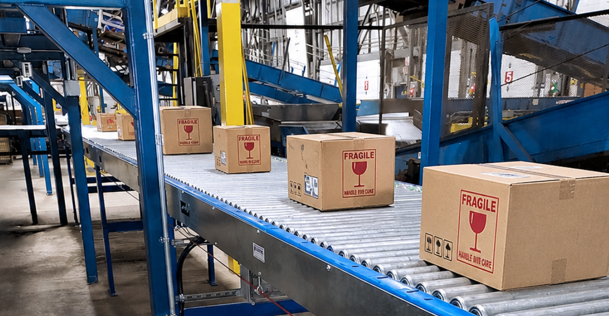
You’ve slowed your packaging line by 20% to reduce product breakage. Damage dropped from unacceptable to manageable. Throughput dropped, too, and now you’re running weekend shifts to hit the same weekly numbers you used to clear by Friday.
MDR conveyors for fragile products solve this through zone control rather than speed cuts. Individual sections work independently, which means gentle starts, controlled stops, and buildup without contact pressure.
Moving a heavy-duty tote or a rugged shipping container down a conveyor is relatively straightforward. Moving a carton filled with glass, sensitive electronics, precision components, or other damage-prone products is a different challenge entirely.
For these applications, simply getting a product from one end of a conveyor line to the other isn’t enough. The system has to control how the product accelerates, stops, accumulates, and interacts with everything around it. Even a relatively minor impact can damage the product, its packaging, or both.
This is where Motor Driven Roller (MDR) conveyor systems offer a major advantage. By dividing a conveyor into independently controlled zones, MDR technology provides much greater control over product movement than traditional continuously driven conveyor designs.
For companies focused on delicate product conveying, that control can make the difference between a smooth material-handling process and an expensive source of product damage.
Why Standard Conveyors Damage Fragile Products
Line shaft conveyors use a single motor to drive the entire line via belts or chains. Turn it on, and everything moves. A carton enters at one end and rides at a constant speed until it exits or hits something.
Buildup creates the first problem. Product backs up at a workstation or transfer point, and upstream flow keeps pushing. Each carton contacts the one ahead with whatever momentum the belt carries. Light packaging absorbs it. Glass bottles don’t.
Belt systems without zone control can’t stop sections independently. Flow halts downstream, but the belt continues to run under the accumulated product. Neither works for delicate product conveying.
Transfers add another failure point. Product leaves one belt at full speed and lands on the next section, often at a different height or angle. Ceramic components chip at the edges. Electronics with loose internal parts take hits that show up as failures later in QC testing.
Why Fragile Products Require a Different Approach
Many conveyor systems are designed primarily around throughput. The faster products can move, the more productive the system becomes—or at least that is the theory.
With fragile products, however, speed without control can quickly become a problem.
A package travelling down a conveyor carries momentum. If it reaches a stopped package and makes direct contact at speed, that energy has to go somewhere. The result may be crushed packaging, scratched components, broken products, or loads that shift inside their containers.
This becomes especially important when products accumulate before another operation. Packaging machines, inspection stations, robotic cells, palletizers, and manual workstations can all create temporary backups. A conventional conveyor may continue pushing products together during these delays.
Effective fragile load handling requires a system capable of responding to these changing conditions rather than simply continuing to drive everything forward.
MDR conveyors are particularly well suited to this type of control.
How Zone Control Prevents Product-to-Product Contact
Zone control conveyor systems divide the line into independently powered sections. Sensors detect when product enters a zone, activate only that section’s motor, and power down when the product exits.
Buildup works differently. Product stops in zone three because downstream processing isn’t ready. Zone three powers down. Product still flowing from upstream enters zone two, which also powers down once occupied.
The product queue forms through sequential zone shutdown, not through physical stacking.
Walk past a zone control system during buildup and you’ll see cartons sitting motionless with visible gaps between sections. No compression. No sliding. Each unit waits independently until downstream flow resumes.
Gentle acceleration prevents startup shock. Individual zones ramp motor speed gradually when product needs to move forward. A carton transitions from stationary to line speed over a controlled distance instead of instantly. Glass bottles don’t shift in their packaging.
Zero-Pressure Accumulation Eliminates Stacking Force
Standard buildup relies on product physically touching to create backpressure. That works fine for corrugated boxes. It doesn’t work for fragile load handling where any contact risks damage.
Zero-pressure buildup through MDR eliminates physical contact entirely. Sensors detect product presence in each zone before it reaches the downstream unit. Product accumulates in a queue with millimeter-level spacing, but there is no actual contact between units.
Automotive electronics assembly uses this extensively. Circuit boards in trays move through robotic pick-and-place cells. The boards can’t touch each other because even minor impacts can dislodge surface-mount components.
Packaging lines benefit when filling operations run at variable speeds. The buildup zone holds filled bottles without contact pressure while waiting for the capper to clear. Breakage from stacking force drops to near zero.
Gap control adjusts based on product characteristics. Lightweight cartons need minimal spacing. Heavy glass containers require larger gaps to account for momentum if upstream feeding doesn’t stop precisely.
Precision Stops Without Hard Deceleration
Robotic work cells pick products at fixed positions. The conveyor must stop each unit precisely without overshoot. Standard belt systems brake the entire line when product reaches position, which creates a sudden deceleration that can tip unstable loads.
MDR zones decelerate individual sections independently. A carton approaches the pickup station, and that zone’s motor gradually reduces speed over a programmed distance. The product comes to rest exactly at the pickup point without an abrupt stopping force.
This matters most for tall, narrow products with high centers of gravity. Boxed monitors standing vertically. Cylindrical containers that can roll if the momentum shifts suddenly.
Vision inspection stations need this precision too. Any motion blur from vibration or continued belt movement creates read failures. Zone control delivers true stationary positioning. Image quality improves enough to reduce product damage from unnecessary rejects and rework.
What Makes an MDR Conveyor Different?
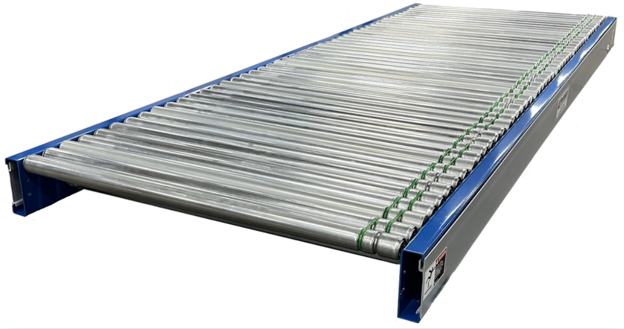
Instead of relying on one large motor to continuously power a long conveyor section, MDR systems use compact motors built directly into selected conveyor rollers.
These motorized rollers typically drive a small group of adjacent carrying rollers, creating an individual conveyor zone. Sensors and controls can then determine when each zone should run and when it should stop.
The result is a conveyor made up of independently controlled sections rather than one continuously moving surface.
For example, when a product enters a zone, a sensor can detect its presence. If the downstream zone is clear, the conveyor continues moving the product forward. If another product is occupying that zone, the upstream zone can stop and hold its load in position.
This simple concept is the foundation of the zone control conveyor.
Instead of allowing products to pile into one another, each load can occupy its own controlled section of conveyor.
Synchronized Transfers Eliminate Freefall Impact
Conventional conveyor transfers operate on fixed timing. Belt speeds drift slightly. Product doesn’t always sit square. Gaps between conveyor sections create drop distances where product free-falls briefly before landing on the next section.
That free-fall damages fragile products even over short distances. A glass jar drops three inches and impacts the receiving belt. The jar survives, but the internal vacuum seal takes a shock load. Weeks later, shelf-stable product spoils because the seal failed microscopically during that transfer impact.
MDR systems synchronize transfer points through sensor communication. The upstream zone detects product approaching the transfer gap, signals the downstream zone to match speed exactly, and coordinates timing so the receiving section is already moving at transfer speed when product arrives. When synchronized properly, gap distance becomes irrelevant because product never free-falls.
Height transfers benefit most from this coordination. Conventional systems rely on product momentum to carry it up the incline. Zone-synchronized transfers power the receiving section before product arrives, actively pulling the item across the elevation change. No impact shock, no tipping risk.
Better Control at Transfers and Process Points
Transfers are another area where fragile products can experience damage.
Whenever a product moves between conveyors, changes direction, or enters a workstation, differences in speed can create impacts. A package arriving too quickly may strike a guide rail, another conveyor, or equipment positioned downstream.
MDR systems give designers more flexibility to control how products approach these areas.
Zones near a transfer point can operate differently from the rest of the conveyor. Products may travel quickly through open sections of the system and then slow as they approach a critical transfer or workstation.
This allows a conveyor system to balance throughput with careful fragile load handling rather than forcing designers to choose one fixed operating speed for the entire line.
Movement Only When Movement Is Needed
Another useful characteristic of MDR systems is that conveyor zones don’t necessarily need to run continuously.
A zone can remain stationary until a product enters it or until downstream conditions require movement. This “run on demand” approach has benefits beyond energy efficiency.
It means fragile products aren’t constantly sitting on top of rotating rollers while waiting for downstream equipment.
For some products and packaging materials, unnecessary roller movement can cause abrasion, vibration, or wear. Eliminating unnecessary motion provides another way to reduce product damage throughout the conveying process.
It also reduces conveyor noise and mechanical wear, which can be valuable in facilities where conveyors operate for long periods.
Smarter Conveyor Control for Changing Conditions
Modern production and distribution environments rarely operate under perfectly consistent conditions.
A packaging machine may pause. An operator may need extra time at an inspection station. A robot may temporarily stop while completing another task. Downstream equipment may become unavailable for several minutes.
A zone control conveyor can respond to these situations locally.
Instead of shutting down an entire conveyor or allowing products to accumulate under pressure, individual zones can hold products safely until the downstream process is ready again.
This makes MDR especially useful in automated systems where equipment needs to communicate and react to changing conditions throughout the line.
Designing MDR Conveyors for Fragile Products
MDR technology provides the tools for controlled conveying, but successful applications still require careful system design.
Roller spacing, conveyor speed, zone length, product weight, packaging construction, sensor positioning, transfer design, and control logic all influence how safely a product moves.
The product itself should ultimately determine the conveyor configuration.
A lightweight cardboard carton containing glass bottles, for example, may require a very different roller arrangement from a rigid tote carrying precision-machined components. Both products may be considered fragile, but the way they interact with the conveyor is completely different.
This is why MDR conveyors for fragile products should be designed around the actual load rather than treated as a one-size-fits-all solution.
Testing representative products can also reveal issues that aren’t obvious from dimensions and weights alone. Packaging may flex, loads may have unusual centers of gravity, and certain containers may behave differently during acceleration or transfers.
Protecting the Product Without Sacrificing Productivity
Protecting fragile products doesn’t necessarily mean running a conveyor system slowly.
The real objective is controlled movement.
Products can move efficiently through open sections of a conveyor while slowing, stopping, or accumulating only when conditions require it. MDR technology makes this possible because individual zones can respond independently rather than forcing the entire conveyor to operate as a single unit.
That flexibility allows manufacturers and distribution facilities to maintain useful throughput while reducing unnecessary impacts and product contact.
When product damage means scrap, rework, returns, customer complaints, or lost production time, preventing those impacts can provide value well beyond the conveyor itself.
A Gentler Way to Keep Products Moving
Conveyors don’t always need more power. Sometimes they need more control.
For fragile and high-value products, MDR technology provides that control by managing loads individually, minimizing pressure during accumulation, and allowing product movement to respond to real-time conditions.
A properly designed MDR system can provide smoother acceleration, controlled stopping, zero-pressure accumulation, and carefully managed transfers—all while maintaining efficient material flow.
For manufacturers looking to improve delicate product conveying, investing in MDR conveyors for fragile products can help create a handling system that protects the product without creating a bottleneck.

When High-Value Products Justify the Investment
Not every operation needs zone control. Corrugated boxes moving through a distribution center tolerate contact and abrupt stops without damage. The added cost of MDR conveyors for fragile products doesn’t make sense when standard systems work fine.
Calculate your current damage rate as a percentage of total throughput. Track where breakage happens. If damage concentrates at specific points, such as transfer or buildup zones, zone control directly addresses those failures.
Product value matters. Breaking one unit per thousand on a $2 item costs differently than breaking the same rate on a $200 item. High-value electronics, medical devices, and specialty glass justify MDR investment faster.
Throughput volume amplifies the calculation. A line moving 50 units per hour with 2% damage loses one unit per hour. The same rate at 500 units per hour loses ten. As volume scales, even small percentage improvements translate to significant cost recovery.
Ontario manufacturing facilities handling automotive glass components see clear justification. A cracked windshield caught in-house costs the replacement glass. One that reaches the assembly plant before the damage shows can trigger emergency air freight for the replacement and potential line stoppage penalties.
Preventing the initial stress that leads to delayed failures cuts that exposure. Zone control eliminates downstream exposure.
Reducing Product-to-Product Contact
One of the biggest advantages of MDR technology for fragile applications is zero-pressure accumulation.
Traditional accumulation systems may allow cartons or totes to contact one another while continuing to apply some degree of driving force. That may be perfectly acceptable for rugged products, but it introduces unnecessary risk when handling delicate loads.
A properly configured MDR conveyor can maintain separation between products during accumulation.
When the downstream zone becomes occupied, the upstream zone stops before its product reaches the load ahead. As downstream space becomes available, the zones restart in sequence.
This ability to control accumulation can help reduce product damage because products aren’t repeatedly bumping, pushing, or compressing against each other.
The benefit becomes even more noticeable on lines where products spend significant time accumulating. Instead of a queue of packages continually pressing forward, loads can wait independently until the system is ready for them.
Retrofitting Existing Lines and Maintenance Requirements
Retrofitting zone control into an established line requires mechanical and electrical compatibility. You don’t need to convert an entire 200-foot line at once. Start with the problem sections, wherever damage concentrates, and retrofit those zones first.
MDR operates on 24VDC power with Ethernet-based zone controllers, designed to meet ANSI/CEMA Standard 407 for motor driven live roller conveyors. Modern plants with existing Ethernet infrastructure integrate faster, and CEMA-compliant systems ensure component compatibility across different manufacturers.
The automotive battery tray system case study shows what full MDR implementation looks like. Hundreds of meters of Poly-V MDR with pop-up transfers and indexing controls.
Zone control reduces wear on individual motors compared to continuous-run systems. One failed motor affects one zone, not the entire line. You can bypass a failed zone temporarily and continue operating.
A zone operating 40% of each shift accumulates wear proportionally slower than a line shaft roller spinning continuously. Replacement conveyor rollers last longer under intermittent duty.
Temperature swings affect both product and conveyor performance. Loading dock areas see the widest variation. Trailer doors open, minus 20°C outside air floods in, product experiences thermal shock. Zone control can’t prevent temperature-related brittleness, but gentle handling reduces mechanical stress that might trigger cracks. Canadian conveyor manufacturers account for these conditions in system design.
Controlled Starts and Stops Matter
Product collisions aren’t the only potential source of damage.
Sudden acceleration and abrupt stopping can also create problems, particularly when the contents of a carton aren’t tightly secured. A package may remain perfectly intact while the product inside shifts, tips, or collides with its packaging.
Depending on the controls and MDR components being used, acceleration and deceleration can be managed much more carefully than with a simple on/off conveyor.
Rather than immediately applying full speed, a zone can bring the product up to operating speed more smoothly. Similarly, controlled deceleration can reduce the forces experienced when a product needs to stop.
For delicate product conveying, this more predictable motion can be especially useful for glass products, electronics, precision assemblies, sensitive instruments, and packages containing loosely secured components.
Why Padded Belts Don’t Solve the Core Problem
Some facilities try to solve fragile product damage through belt material changes such as switching from PVC to urethane belts, or adding foam padding. Those modifications help, but they don’t address the fundamental problem. Standard systems still accumulate through contact and transfer through free-fall.
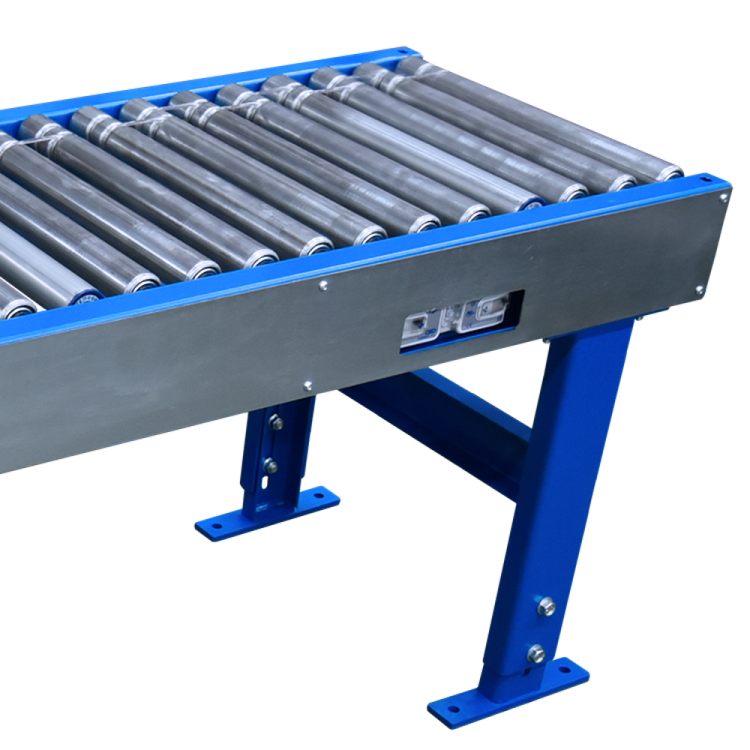
Roller conveyors with zone control deliver gentler handling than belts because rollers create point contact instead of surface contact. The heavy-duty conveyor selection guide covers roller capacity ratings and application fit.
Upfront Cost Versus Long-Term Damage Reduction
Purchase price for MDR systems runs higher than equivalent line shaft or belt conveyors. The gap narrows when you factor in installation costs. 24VDC wiring requires lighter electrical infrastructure than high-voltage motor circuits.
Payback depends on current damage rates and product value. High-value products that require delicate product conveying with frequent breakage justify investment in zone control conveyors faster than low-value items with occasional damage.
Track damage location precisely before speccing equipment. If 80% of breakage occurs at two specific transfer points, you don’t need a full line retrofit. Zone control conveyors at those critical sections might solve the problem for a fraction of full system cost.
Your current approach to fragile load handling works until it doesn’t. Slowing line speed reduces damage but kills throughput. Adding operators to manually guide products increases labor cost. Both are expensive workarounds that don’t address the root problem.
Zone control conveyors address the mechanical causes of conveyor-related damage. Contact pressure, abrupt acceleration, unsynchronized transfers. If you want to assess whether it makes sense for your operation, reach out to our Cambridge team at info@rolmasterconveyors.ca.