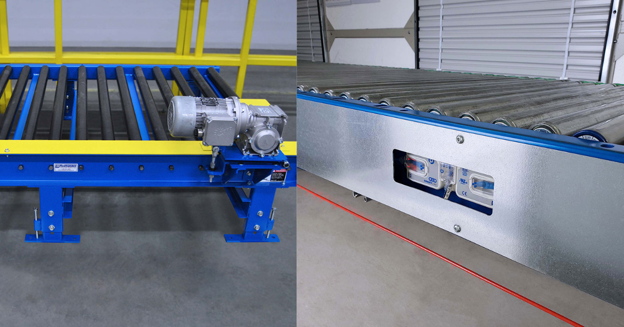
Motor driven roller (MDR) and chain driven live roller (CDLR) conveyors both move product on powered rollers, but they solve different problems. MDR uses 24VDC motors with zone control for package handling. CDLR uses AC motors driving chains that turn sprockets welded to rollers, built for heavy pallets and contaminated environments where enclosed drives are essential.
Get the match wrong, and you either overpay or under-spec. Here we answer the questions you may have about MDR vs CDLR.
What Is a CDLR Conveyor?
A Chain Driven Live Roller conveyor, commonly shortened to CDLR, uses chains and sprockets to transfer power from a drive unit to the conveyor rollers. Rather than relying on friction alone, the rollers are positively driven, creating a durable conveying system capable of moving substantial loads.
This construction makes CDLR conveyor systems particularly useful in demanding industrial applications.
Typical products handled by CDLR conveyors include:
- Pallets
- Steel containers and racks
- Drums
- Automotive components
- Heavy machinery components
- Large industrial products
- Heavy unit loads
One of the biggest advantages of CDLR is its ability to handle products that would simply be too heavy or demanding for many lighter-duty conveyor technologies.
CDLR conveyors can also be configured with different roller diameters, roller centres, frame sizes, chains, sprockets, and drive arrangements depending on the load and application.
That flexibility makes them a familiar sight in manufacturing plants, warehouses, automotive facilities, pallet handling systems, and other heavy industrial environments.
What Is an MDR Conveyor?
Motor Driven Roller, or MDR, takes a different approach.
Instead of using a conventional motor and chain arrangement to continuously power a large group of rollers, an MDR conveyor uses compact motors incorporated into selected rollers. These powered rollers can then drive adjacent carrying rollers, typically through belts or similar transmission methods.
One of the major advantages of this design is the ability to divide a conveyor into independently controlled zones.
A product entering one zone can activate that section of conveyor while other zones remain stationary. Sensors and controls determine when individual sections need to run.
This makes MDR especially useful for applications involving:
- Cartons
- Boxes
- Totes
- Cases
- Packaged products
- Order fulfillment
- Sorting and distribution
- Zero-pressure accumulation
Rather than treating an entire conveyor as one continuously operating machine, MDR allows individual sections to respond to products as they move through the system.
The Mechanical Split That Drives Everything Else
MDR systems place small DC motors inside individual rollers. At least one motorized roller per zone drives the others through O-ring or poly-V belt connections. Sensors detect product and power only active zones.
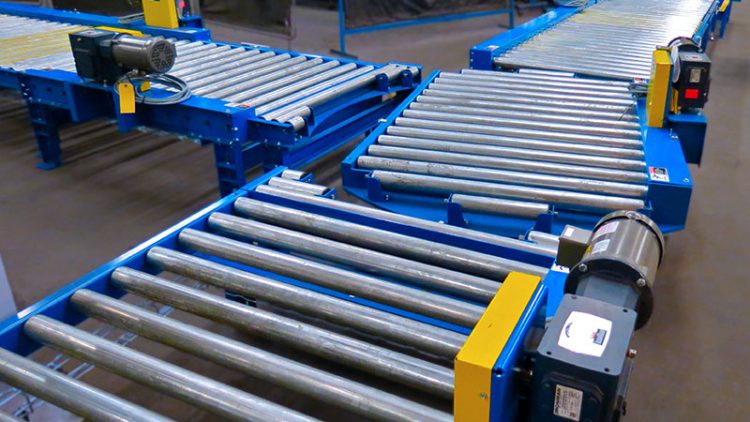
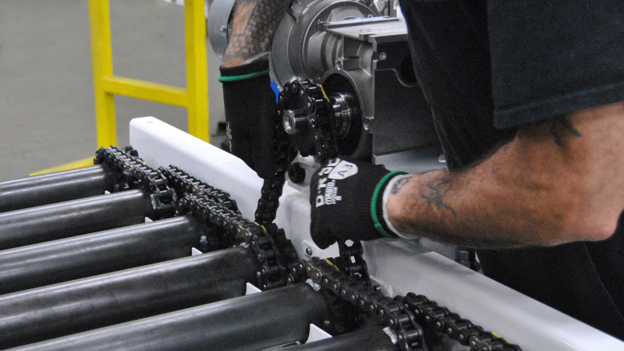
CDLR runs drive chains alongside the roller bed. Sprockets welded to each roller connect to the chain. When the motor turns the chain, every connected roller turns simultaneously.
Modern Materials Handling’s Equipment 101 conveyor primer notes that the 24VDC motors in MDR draw less energy than the motors driving other forms of roller conveyor, and the zones can be configured to run only when a package is present. Both CEMA Standard 404 and CEMA Standard 407 establish the engineering specifications here, 404 governing chain driven live roller systems and 407 covering motor driven live roller conveyors.
The mechanical difference creates the application split. MDR’s zone control means a roller spinning air costs nothing. CDLR’s continuous operation means every roller runs whether product occupies that section or not.
Empty Conveyor Is Where MDR Pays You Back
Distribution centres moving cartons and totes see the biggest MDR advantage, and it comes from a specific operational reality: most lines don’t run full. If product occupies 30% of your conveyor at any given moment, a line shaft system still powers the other 70%. MDR doesn’t.
That changes accumulation as much as it changes energy. Zero-pressure zones stop independently when sensors detect that the downstream zone is occupied, leaving gaps that prevent contact damage on fragile cartons. The same zone logic isolates failures. One motor drops out, one zone stops, and the rest of the line keeps running. A line shaft conveyor with a failed drive section takes the whole segment down.
The 24VDC motors draw less energy than the AC motors used to drive other powered roller types and produce less torque, which keeps the system below standard shock-hazard thresholds. That simplifies guarding and access for maintenance.
Our distribution centre upgrade work replaced aging line shaft with O-Ring MDR at 50 pounds per foot, using MDR curves to recover floor space that the old layout couldn’t. The energy advantage compounds where it can, on lighter loads with sporadic flow and frequent accumulation. Run a line near full occupancy, and the savings narrow.
Where CDLR Outperforms MDR
Heavy loads shift the equation. CDLR handles pallets from 1,000 pounds and up, well beyond what MDR’s low-voltage motors can drive. Automotive assembly lines moving engine blocks, stamped steel components, or loaded work-in-process pallets need the torque and structural capacity CDLR provides.
The positive drive (chain-to-sprocket connection) doesn’t slip under load. MDR’s O-ring or belt drive can lose traction on heavy products, especially during acceleration or on inclines. You’ll see it happen when a pallet with concentrated weight hits a zone. The drive roller spins, the driven rollers stutter, and the pallet stops moving. CDLR maintains a consistent drive force regardless of load distribution.
Contaminated environments favour CDLR. Metalworking facilities, stamping operations, and any production floor with oil, coolant, or airborne debris call for an enclosed drive system. CDLR’s chain drive runs sealed inside guards, which protects the power transmission from contamination that exposed drives can’t handle as well over time.
CDLR has fewer electronic components: basic AC motors, chain, sprockets, and guards. The troubleshooting question is whether the chain is tight and the sprockets are worn, not which zone controller dropped off the network.
How Load Capacity Actually Works
MDR is built for light to medium-weight packages and tops out well below CDLR’s range. CDLR starts where MDR stops and scales up from there.
Concentrated weight (a pallet with product stacked in the centre) creates point loads that stress individual rollers. CDLR’s positive drive distributes force across the entire chain system. MDR relies on friction between rollers, which fails when load concentration exceeds grip capacity.
CDLR moves pallets slowly under heavy weight. MDR runs faster for lighter loads, with our automotive pallet handling case study confirming sustained operation at 140 FPM on twin-run MDR.
Where Energy Costs Actually Come From
High-volume operations running near full occupancy don’t see the MDR energy savings the spec sheet promises. If your line runs at 85% occupancy across two shifts, you’re powering nearly everything anyway, and the premium over CDLR takes longer to recover.
The savings live in the gap between rated capacity and actual use. A line shaft conveyor running 16 hours daily powers rollers whether product moves through or not. MDR’s zone control attacks that directly.
Zone control extends the advantage when it coordinates with upstream and downstream equipment. Sections shut down when a robotic cell needs extra cycle time or production pauses for changeover. Manual operations rarely use this capability, which means part of what you paid for sits idle.
24VDC systems run on a different electrical distribution than 480VAC CDLR installations. Facilities already running high-voltage systems may find adding 24VDC creates more complexity than it solves.
Maintenance: What Actually Breaks
MDR maintenance happens at the zone level. A motor fails; you replace one roller. O-rings wear; you swap them during scheduled PM. The work is electrical: motor diagnostics, sensor adjustment, and controller programming. You need someone comfortable with multimeters and PLC software, not wrenches.
CDLR conveyors are mechanically robust, but their construction includes components such as chains, sprockets, bearings, motors, and gear reducers.
These components need to be considered as part of a facility’s maintenance program. Chains may require inspection, tension adjustment, lubrication, or eventual replacement depending on the conveyor design and operating environment.
The advantage is familiarity. Industrial maintenance teams are generally comfortable working with motors, chains, sprockets, and bearings.
MDR systems eliminate some of the traditional mechanical drive components, but introduce additional electrical and control components.
CDLR maintenance is mechanical. Chain stretch requires periodic tension adjustment. Skip it, and the chain jumps off the sprockets during acceleration. Sprockets wear and need replacement. The work requires mechanical trade skills: alignment, measurement, and lubrication. A millimetre off on sprocket alignment creates vibration that wears bearings faster than the load does.
Chain life depends on the environment. A clean warehouse running CDLR can go years between chain replacements. A stamping plant with airborne particulate may replace them more often, as the grit works into the roller links and grinds at the pins. The trade-off is still worth it: CDLR wears faster in those conditions but keeps running, where MDR fails outright.
MDR avoids the chain problem but substitutes O-ring replacement. Less expensive per item, but more items to track. Miss one worn O-ring, and that zone stops driving the downstream rollers.
Either way, the inspection discipline holds. CCOHS guidance on conveyor safety treats regular inspection for loose or damaged parts as baseline practice, with service work on the drive system done under lockout. The technology choice changes what you’re inspecting. It doesn’t change whether you inspect.
4 Signals That Settle the MDR vs CDLR Call
The decision rarely comes down to a single number. Four signals matter more than anything on the spec sheet.
Load shape. A pallet’s rated weight distributed evenly across four rollers is not the same load as that weight concentrated on two. chain driven live roller’s chain-and-sprocket connection handles point loads where motor driven roller’s friction drive starts slipping.
Environment. The contamination question isn’t whether your floor looks clean during a walkthrough. It’s what hits the rollers during a bad shift, in volumes the warranty math doesn’t account for. Anything beyond clean packaged-goods space tilts toward CDLR.
Trade-skill mix. A maintenance team built around mechanical work handles chain driven live roller with the wrenches and feeler gauges they already own. A team comfortable with PLC programming and sensor diagnostics gets full value out of motor driven roller.
Automation context. Motor driven roller communicates over Ethernet and other standard industrial protocols, with zone controllers reporting status, accepting commands, and logging diagnostic data. Chain driven live roller integration is simpler. Motor starters, basic sensors, limit switches, with product tracking handled by external photo eyes and proximity switches.
Cells that need product-tracking data and zone-by-zone handshakes need motor driven roller for connected automation. Manual or semi-automated processes won’t use the data motor driven roller generates, which makes chain driven live roller’s lower cost per foot the right answer.
CEMA standards establish load ratings and dimensional specifications for both, but the rating only tells you maximum capacity. How loads distribute across rollers and how often peak loads occur determines whether a system rated for your maximum will handle your actual operation.
CDLR vs. MDR: Load Capacity
Load capacity is often the first major difference to consider.
For heavy-duty conveying, CDLR is generally the stronger candidate. Its chain-driven construction is designed to transmit substantial torque through the rollers, making it suitable for pallets and other heavy products.
A manufacturing facility moving loaded pallets, for example, will often have requirements that favor chain driven live roller.
Motor driven roller is generally intended for lighter unit loads. It performs particularly well with cartons and totes where extremely high roller torque isn’t required.
This doesn’t mean MDR is inherently a light-duty product. Modern MDR systems can handle significant loads when correctly designed. However, once an application begins moving very heavy products, CDLR frequently becomes the more practical solution.
Accumulation and Product Control
This is where motor driven rollers (MDR) has a significant advantage.
Traditional powered conveyor systems often require additional mechanical or control components when products need to accumulate. MDR systems are naturally suited to zone-controlled conveying.
Each conveyor zone can operate independently, allowing products to move forward only when the next zone is available.
This is commonly called zero-pressure accumulation.
Instead of cartons pushing against one another while waiting downstream, individual products can be held in separate zones. This reduces product-to-product contact and gives the control system much greater authority over product movement.
For operations handling fragile packaging, variable product sizes, or automated sorting, this level of control can be extremely valuable.
CDLR can also be incorporated into sophisticated automated systems, but if frequent accumulation and individual product control are primary requirements, MDR will often provide a more natural platform.
Energy Consumption
Another major difference between chain driven live roller and motor driven roller is how the conveyors operate when products aren’t moving.
A traditional CDLR conveyor may use a centralized motor to drive a substantial section of conveyor. Depending on the system design and controls, that section may continue operating whether every roller is actively transporting a product or not.
MDR can operate much more selectively.
If only one section of conveyor needs to move a carton, only the required zones may need to run. Once the carton leaves, those rollers can stop until another product arrives.
In facilities containing hundreds of feet of conveyor, reducing unnecessary conveyor operation can contribute to lower energy consumption.
It can also reduce unnecessary mechanical wear.
Noise and Working Environment
For facilities where employees work alongside conveyor equipment, operating noise can also influence conveyor selection.
Chain-driven conveyors inherently contain moving mechanical components. In a heavy industrial facility, the resulting operating noise may be relatively insignificant compared with surrounding machinery.
MDR systems can provide noticeably quieter operation because they don’t require the same continuous chain-and-sprocket drive arrangement.
That can make MDR attractive in distribution centres, packaging operations, fulfillment facilities, and other environments where employees spend significant amounts of time near conveyor lines.
Controls and Automation
MDR really begins to distinguish itself when conveyor operation becomes more sophisticated.
Because the system is already divided into individually controlled zones, MDR works naturally with sensors, programmable logic controllers, warehouse control systems, scanners, and automated routing equipment.
Products can be released individually, accumulated without contact, redirected, tracked, or synchronized with downstream equipment. CDLR can absolutely be integrated into automated systems as well. In fact, CDLR is frequently used in automated pallet handling applications.
The difference is often the scale of control. If the objective is to move a 2,000-pound pallet between manufacturing processes, CDLR may be exactly what the application needs. If the objective is to independently control dozens of cartons moving through accumulation zones, scanners, transfers, and sortation points, MDR may offer a much more efficient approach. Both powered roller conveyors have their strengths and weaknesses in this area, but MDR truly shines in its versatility.
Most Facilities Need Both
The MDR vs CDLR decision isn’t about which technology is better. MDR solves energy cost, precise control, and flexible accumulation. CDLR solves heavy capacity, contaminated environments, and mechanical simplicity.
Facilities often need both. Distribution centres specify CDLR at the dock and MDR downstream. Automotive plants use CDLR for assembly line pallet transport and MDR for parts presentation. Pop-up chain and urethane belt transfers handle the directional changes where these technologies meet, which is how our battery tray and bin transfer projects connect zones.
The mistake is specifying one technology for everything because you understand it or because a previous installation worked. The receiving dock has different requirements than the pack station. Engineer each zone to its actual load and flow rather than forcing one solution across incompatible applications.
Reach out to our technical account executives to walk through these four signals against thousands of prior designs from our Cambridge facility, including the projects that look like yours. Call 519.740.3201 or info@rolmasterconveyors.ca.