
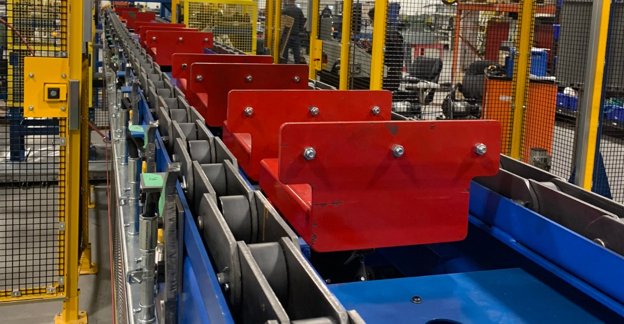
CEMA standards conveyor design aspects aren’t regulatory requirements. No provincial inspector will shut down a line because a conveyor isn’t CEMA compliant. What the standards do is set a consistent engineering baseline: load ratings calculated the same way, roller dimensions that match across suppliers, and components that interface without custom fabrication.
Rolmaster has built to CEMA Standards throughout its 80-year history. That commitment runs through every load rating we publish, every roller spec we quote, and every system that leaves our Cambridge facility. It’s the engineering discipline that makes our specs verifiable at the specification stage, not just on paper.
The Conveyor Equipment Manufacturers Association has published engineering standards since 1933. Those standards cover every major conveyor type used in unit handling, including belt conveyors, chain driven live roller (CDLR), motor driven roller (MDR), line shaft, and gravity roller. CEMA defines more than 150 conveyor types in total, each specified by load capacity, rated speed, throughput, frame configuration, and drive location.
That range of coverage matters because it applies one vocabulary and one set of engineering criteria across the full product range. A facility running CDLR for pallet handling and MDR for carton accumulation can compare both against the same published framework.
What Is CEMA?
CEMA stands for the Conveyor Equipment Manufacturers Association. The organization represents companies involved in the design and manufacture of conveyor equipment and components.
Over the years, CEMA has developed engineering publications covering numerous areas of conveyor technology. These resources establish commonly accepted terminology, design practices, dimensional guidelines, and methods for evaluating conveyor equipment.
Rather than approaching every conveyor as an entirely new engineering problem, manufacturers can use established industry knowledge as a starting point.
A conveyor design standard can help engineers answer fundamental questions such as:
How much weight can a conveyor safely support?
How should that load be distributed?
What roller spacing is appropriate for the product?
What type of conveyor is appropriate for a particular application?
How should components be selected for the expected operating conditions?
What terminology should manufacturers and customers use when discussing conveyor equipment?
Establishing common practices is particularly valuable in industrial environments where conveyor systems from multiple manufacturers may eventually need to operate together.
Why CEMA Standards Matter in Conveyor Design
A conveyor has to do considerably more than simply move a product.
It must support the load without excessive deflection, maintain product stability, operate at the required speed, withstand repeated use, and provide acceptable service life. Powered conveyors must also transmit enough torque to move the product without unnecessarily overstressing chains, bearings, shafts, sprockets, rollers, or drive components.
CEMA standards for conveyor design provide a structured engineering foundation for considering these factors.
This does not mean every conveyor will have the same construction. Conveyor systems are frequently customized around the products they handle and the environment in which they operate.
A distribution center moving lightweight cartons, for example, has very different requirements from a manufacturing facility transporting 2,000-pound steel fabrications. Both facilities may use roller conveyors, but the frames, rollers, bearings, shafts, drives, and support structures could be dramatically different.
CEMA guidance helps designers evaluate those requirements systematically.
What CEMA Standards Conveyor Design Actually Governs
CEMA publishes a separate standard for each conveyor type. For unit handling (pallets, cartons, totes, bins), the key ones run as a numbered series. ANSI/CEMA 401 covers non-powered roller conveyors. ANSI/CEMA 402 covers belt conveyors. ANSI/CEMA 404 covers CEMA-compliant conveyor design for chain driven live roller systems. ANSI/CEMA 407 covers motor driven live roller conveyors.
CEMA is a trade association whose standards are developed by the manufacturers who build this equipment. The criteria come from real production experience, which is what makes them useful at the specification stage rather than just on paper.
Each standard answers the same core questions: how load capacity is calculated, what roller diameters apply to which duty classes, how components connect dimensionally, and what conditions the equipment is rated for. ANSI/CEMA 102 sits underneath all of them. It’s a glossary that keeps the language consistent across every standard in the library.
That shared vocabulary is what makes a roller specification from one CEMA-compliant manufacturer mean the same thing as one from another. That’s where the practical value of compliance starts. The full publications library is at cemanet.org/resources/publications.
Understanding Conveyor Load Ratings
One of the most important aspects of conveyor engineering is determining how much weight the equipment can safely carry.
Conveyor load ratings can refer to several different things depending on the equipment being discussed.
For example, engineers may need to consider:
- individual roller capacity
- bearing capacity
- shaft capacity and deflection
- frame capacity
- support capacity
- chain pull and allowable chain loading
- drive capacity
- maximum product weight
- maximum distributed load
- concentrated or point loading
These values are related, but they are not interchangeable.
Suppose a roller is rated to support a particular load. That does not automatically mean that multiplying the roller rating by the total number of rollers provides the allowable conveyor capacity.
The product may only contact a small number of rollers at any given time.
A pallet travelling across a roller conveyor, for instance, may have only several rollers supporting each runner. Those rollers must carry the actual load transferred through the pallet rather than an equal fraction of the load across every roller in the conveyor.
This is why conveyor load ratings have to be considered at the system level.
How Roller Specifications Connect to Load Ratings
Conveyor roller specifications are where CEMA’s dimensional standards get practical. Roller diameter, tube wall thickness, axle size, and bearing selection all carry load implications. A 1.9″ roller handles different distributed loads than a 2.5″ or 3.5″ roller at the same spacing. That’s where conveyor load ratings come from: how those variables combine across the full conveyor section, not just at one point.
CEMA treats the roller, the frame, and the drive as a system. That’s why two conveyors with the same roller diameter can carry different rated loads. The frame gauge, axle diameter, and bearing spec all factor in.
Miss the bearing spec and the system is undersized, even if the rollers look right on paper. This is why CEMA-compliant manufacturers document these specs as a package, not as separate line items. A roller spec without a bearing spec isn’t a complete load rating.
At Rolmaster’s Cambridge facility, roller selections follow CEMA duty classifications from light duty through heavy duty. Our medium-duty line covers up to 770 lbs per roller. Our heavy-duty line handles up to 1,000 lbs. Both are rated to CEMA criteria, so the numbers hold up in a facility audit or capital equipment review.
A procurement team comparing quotes from multiple suppliers can use those numbers directly without asking each supplier to convert from their own internal scale. For help confirming roller specs against your load requirements, our replacement conveyor rollers measurement guide covers the process step by step.
When Load Ratings Get Applied to CDLR and MDR Systems
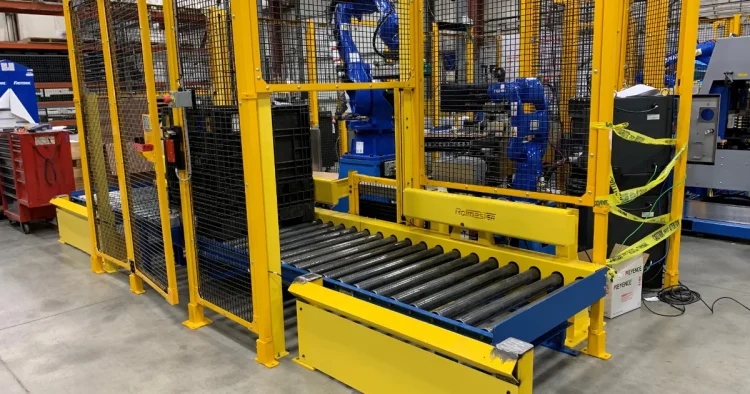
Unit handling conveyor standards matter most when you move from single rollers to full conveyor systems. For pallet handling, the two standards in play are ANSI/CEMA 404 for CDLR and ANSI/CEMA 407 for MDR. They govern different drive methods and different design conditions.
CDLR systems use chains and sprockets to drive rollers directly. The drive is positive regardless of load or surface condition. CEMA 404 sets the criteria for that drive method: sprocket sizing, chain selection, guarding requirements, and load distribution across the roller bed.
Heavy automotive bins in the 950 to 1,859 lb range call for that kind of drive. We’ve handled this application in Ontario automotive plants, and the CEMA 404 criteria are what the load engineering requires. The standard also covers guarding for the chain drive, which matters in facilities where personnel access the conveyor area during operation.
MDR systems work differently. Each zone runs on a 24VDC motor with its own control. The system only powers where product is present. CEMA 407 covers zone control, motor integration, and accumulation practice for these systems.
Our twin-run MDR installation moves 650 lb pallets at 140 FPM. It runs zone control precisely, integrates with turntables and pop-up transfers, and operates efficiently across the full line. The energy side of that performance is covered in our article on how MDR technology reduces energy costs.
CEMA doesn’t tell you which technology to use. That’s engineering judgment based on the conveyor load ratings, the environment, and the production requirement. What CEMA does is define how each system is designed, rated, and documented, so the comparison between options rests on the same criteria.
Gravity Conveyor Design
Gravity roller conveyors are among the simplest types of unit handling equipment, but proper engineering is still necessary.
Because there is no powered drive controlling product movement, designers have to consider factors such as product weight, roller resistance, slope, product stability, and stopping requirements.
A gravity conveyor installed completely level may require operators to push products manually. When installed on an incline, gravity can move the product automatically.
The required slope depends on several variables, including load weight, roller diameter, bearing resistance, and the condition of the product’s conveying surface.
Too little slope can cause products to stall.
Too much slope can cause loads to accelerate excessively.
This illustrates an important principle behind unit handling conveyor standards: conveyor performance depends on the interaction between the equipment and the product.
Powered Roller Conveyor Design
Powered roller conveyors introduce additional engineering considerations.
Chain-driven live roller conveyors, for example, use chains and sprockets to transmit power between rollers. Designers must consider chain pull, sprocket selection, roller resistance, drive torque, speed, load weight, accumulation conditions, and the number of rollers being driven.
Motor selection should therefore be based on the actual operating requirements rather than simply choosing a motor size that has worked on a previous conveyor.
An undersized drive may struggle during startup or under maximum load. An unnecessarily oversized drive can increase cost and potentially place additional stress on components if the system is not properly protected.
A properly engineered powered conveyor balances motor output with the mechanical requirements of the conveyor.
Environmental Conditions Matter
A conveyor that works reliably in one facility may perform poorly in another if environmental conditions are ignored.
Temperature, moisture, dust, chemicals, washdown requirements, corrosion, and contamination can all affect component selection.
For example, a standard steel roller may work perfectly well in a dry manufacturing facility but may not be appropriate for a wet or corrosive environment.
Similarly, lubricated bearings that perform reliably in ordinary industrial conditions may require different protection or construction in areas exposed to water, abrasive dust, chemicals, extreme temperatures, or other contaminants.
Standards provide the engineering framework, but environmental information helps determine which materials and components should actually be used.
What Compliance Means on a Canadian Production Floor
Canadian workplace safety rules are clear on one point: operators must not exceed a conveyor’s rated load capacity. That rule is simple. But it only works if the load rating is accurate and documented to a known standard.
A CEMA compliant conveyor arrives with ratings a plant engineer or safety team can verify. A conveyor rated only to a manufacturer’s internal standard doesn’t offer that. There’s no independent benchmark to check against, and no published criteria a plant engineer or safety auditor can point to.
Ontario facilities deal with seasonal temperature swings from -30°C to +30°C. Those swings affect bearing lubrication in ways that offshore specs don’t always account for. Bearing selections in CEMA compliant conveyor equipment are tied to the duty class and operating environment of the conveyor, not a generic ambient assumption. In a Cambridge facility running year-round production, that distinction shows up in bearing life and maintenance intervals.
CCOHS conveyor safety guidelines for Canadian workplaces are at ccohs.ca/oshanswers/safety_haz/conveyor_safety.
Conveyor Safety and Standards
Mechanical performance is only one part of conveyor design standards.
Conveyor systems can contain rotating components, chains, sprockets, pinch points, moving products, transfer points, and powered equipment. These hazards must be addressed during equipment design, installation, and operation.
Depending on the conveyor and jurisdiction, manufacturers and installers may need to consider requirements extending beyond CEMA guidance, including applicable occupational health and safety regulations, electrical requirements, machine guarding standards, and local codes.
For this reason, CEMA guidance should be viewed as one part of the overall design and safety process rather than a replacement for all other applicable requirements.
Proper guarding, emergency stops, lockout procedures, maintenance access, controls, and employee training can all contribute to a safer conveyor installation. Even something as simple as ensuring you are looking at a conveyor with the correct conveyor load ratings is a part of conveyor safety.
What to Confirm Before a Conveyor Order Goes In
CEMA compliance gives buyers confidence in a quote before the order goes in. Load ratings and roller specs calculated to CEMA criteria mean the numbers are standardized. A quoted load rating from a CEMA compliant conveyor manufacturer is directly comparable to any other CEMA compliant conveyor quote.
There’s no conversion required, no back-and-forth asking how the numbers were derived. The criteria are published and the same for everyone building to the standard. CEMA-compliant components also interface dimensionally; so when a system expands, or parts need replacing, the equipment fits without custom adapter work.
CEMA compliance establishes the design baseline. Applying that baseline correctly to a specific application requires engineering judgment, and that’s where working with a manufacturer experienced in comparable applications adds real value. The right CDLR configuration for a 1,500 lb pallet in an automotive plant looks different from the right MDR setup for carton accumulation in a distribution centre, even if both are CEMA compliant conveyors.
Our Cambridge facility handles 120 to 200 projects monthly. We draw on 80 years of design history and a database of thousands of prior configurations. Our technical account executives work with plant engineers at the specification stage, not after the purchase order is in. That means load ratings, roller selections, and drive configurations get confirmed against the actual application before anything is built.
For heavy-duty applications, our heavy-duty conveyor selection guide covers how CEMA duty classifications apply to CDLR and chain conveyor selection.
Standards Do Not Eliminate the Need for Custom Engineering
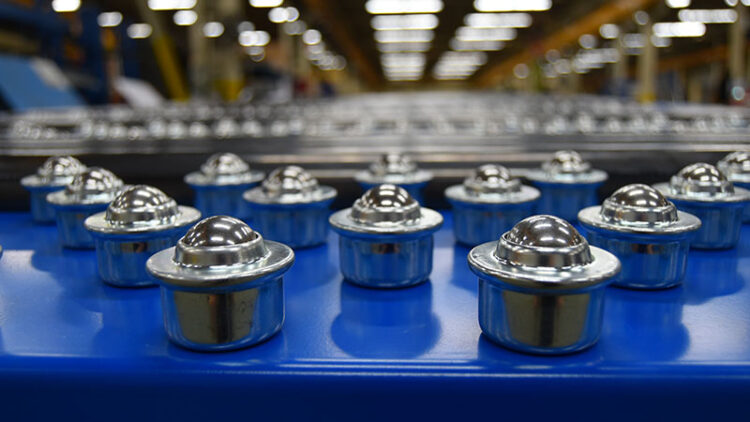
Industrial conveyor systems are frequently customized, and following standards does not mean every system should be identical.
In fact, one of the strengths of established conveyor design standard practices is that they give engineers a reliable foundation from which to develop custom solutions.
A conveyor may need to accommodate unusually wide products, extreme loads, special transfers, restricted floor space, unusual temperatures, washdown requirements, or integration with automated machinery.
These applications may require modifications to standard equipment.
The important point is that customization should be based on engineering requirements rather than guesswork, and should do it’s best to follow a consistent conveyor design standard.
If a standard conveyor component does not provide sufficient capacity, the solution might involve a larger roller, heavier shaft, stronger bearing, reinforced frame, reduced support spacing, or entirely different conveyor technology.
The Supplier Signal Behind the Standard
CEMA compliance is an engineering commitment. Manufacturers who build to it calculate load ratings the same way across every conveyor type, dimension components for predictable interfaces, and document equipment against criteria that a plant engineer or systems integrator can check independently. That consistency is what gives the standard its weight.
Rolmaster has built to CEMA Conveyor Design Standards throughout its history. It runs through every roller specification, load rating, and component selection that leaves our Cambridge facility. When you’re reviewing a quote, asking a supplier to confirm which CEMA standard numbers apply to the equipment they’re quoting is a fast way to verify the load ratings were calculated to a consistent baseline, and gets you to a direct comparison without extra steps.
If you’re speccing a system and want to work through the load requirements, contact our Cambridge team to confirm the right CDLR or MDR configuration for your application and verify that the specs you’re quoting meet CEMA criteria for your load conditions.