Reduced line speed is the most expensive setting in a plant and the least examined. Someone slowed a section years ago for a legitimate operational reason that has since been resolved or forgotten.
The setting stayed, and the run now moves at the pace of its slowest segment. Before pricing a repair or replacement conveyor belt system project, compare the rated speed against what the line delivers.
That gap is usually the business case.
Conveyor equipment is built to work. In many facilities, it runs for thousands of hours each year with very little attention beyond routine maintenance. But eventually, even a well-built conveyor eventually begins to show its age. Belts stretch, bearings wear, frames become damaged, motors lose efficiency, and components that were once readily available become increasingly difficult to source.
At that point, maintenance teams and facility managers face an important question: should you repair or replace conveyor belt system equipment? There isn’t one answer that applies to every operation. A relatively simple repair may keep a conveyor productive for years, while repeatedly repairing an aging conveyor system can eventually cost far more than replacing it. The key is knowing how to tell the difference.
Start With the Speed the Line Actually Runs
Belt speed is a design decision tied to the work being performed. CEMA sets belt conveyors up to run at the speed best suited to the job. They act as a pacesetter for assembly operations, or as a timing medium for the surrounding process.
A run that has been slowed follows a specification nobody wrote down. The original drawing states one number and the drive delivers another. Nobody has reconciled the difference. The change arrived in increments, and every individual adjustment made operational sense at the time.
The underlying reasons are usually findable. A sensor at a transfer point started missing product, so someone reduced the operating speed rather than retiming it. Guarding went on after an incident and made a jam harder to clear. Product changed dimensions and stopped tracking the way it originally did.
Pull the rated speed off the original submittal, then time a product end-to-end with a stopwatch. Two numbers and twenty minutes on the production floor, and the evaluation has its first documented input.
Where the Cost Hides and the Trend Already Shows
Canadian manufacturing ran at 77.7% of capacity in the fourth quarter of 2025. Plants carry spare capacity, and that available room is precisely what absorbs a slower line.
An order rarely gets missed because a single run lost some of its rated speed. The schedule stretches and an hour of overtime covers the difference. The plant still hits its number. The shortfall never reaches a report, so nobody upstream registers that anything changed.
The cost lands somewhere else. Shifts run past their planned end, and operators get staged at transfer points. The line stops accepting new volume without a meeting first, and an aging conveyor system rarely announces itself. It settles into a slower version of the operation, and the plant quietly adjusts around it.
Cost that accommodation before anything reaches finance. Take the overtime hours attached to the affected line across twelve months of production. Add the labour stationed at the transfer point, plus whatever volume was redirected or declined. Most plants have never assembled those three figures on a single page.
Work orders carry the trend before the equipment does. Pull five years of records for one belt run and review them in sequence rather than by category.
Early entries scatter across belt tracking, an occasional bearing, and a coupler replacement following a jam. Later entries repeat, and the intervals between them shorten. Same section, same fault, repeat visits where there used to be one.
Repetition concentrated on one section is the second input into the decision, and most facilities already have it documented. It rarely reaches a budget meeting, because nobody reads a maintenance log chronologically. Sort the history by location instead of by date, and the argument makes itself.
What a Rebuild Returns and What It Doesn’t
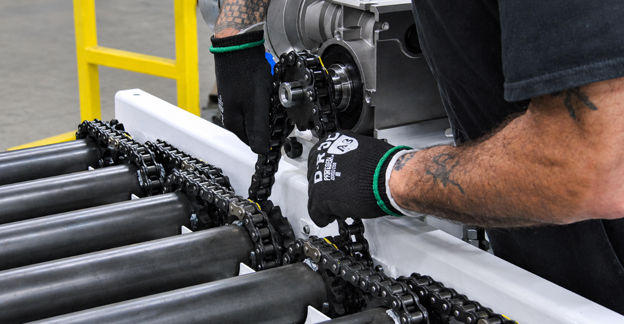
Repair work restores the original performance specification. New belting, fresh bearings, and a drive rebuild return the run to what the drawing promised.
The frame decides whether that investment is worth making. A straight, square frame outlasts everything bolted to it, and a rebuild cannot correct it cheaply. Check for level along the run and square at the transfer points. A string line and a level will tell you most of it, since misalignment often appears at the supports first.
Belting selection is worth revisiting at the same time. Materials differ for wet conditions, heat, and cut resistance. The original choice reflected the product running at the time. Corrugated sidewalls and cleats become relevant if elevation changes have been added since installation.
Wear items are a separate question. Bearing failures often sound like grinding well before they seize, giving maintenance a usable window. Getting a replacement right takes measurement, not memory. Our guide to measuring for replacement conveyor rollers covers what to record before ordering.
Drive sizing is where a rebuild can quietly disappoint an otherwise sound project. Motors get specified against the load in front of the engineer that year. If product weight has climbed since then, a rebuilt drive returns the run to an obsolete rating. Weigh a loaded section before ordering replacement parts.
When the Application Moved and the Line Didn’t
Frames don’t change, although the work surrounding them changes constantly. Product weight climbs after a packaging change, and cycle times tighten when customers shift to smaller orders. A robotic cell arrives at the discharge and wants consistent product positioning.
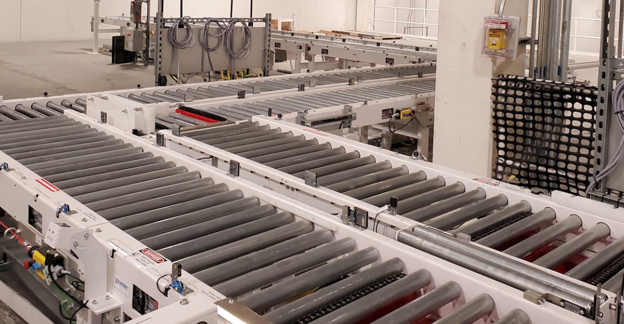
A slider bed belt conveyor carries product across a continuous flat surface, covering what most production lines require. Where heavier pallets or bins now run that route, positive drive changes the specification. We built one system around 3,000 lb steel pallets measuring 47 by 78 inches. A pop-up CDLR lifts through a stationary chain conveyor to complete the transfer.
Accumulation is the other requirement that moves. A cell that requires product to be held and released in sequence needs zone control. One distribution centre upgrade replaced a line shaft run with an O-Ring MDR rated to 50 lbs per foot. MDR curves improved space utilization across the same footprint.
Sensor timing is the requirement that surprises people. Pop-up transfer coordination gets measured in milliseconds, and manual adjustment takes hours of production testing. New cells expect a conveyor line that communicates with them at that resolution.
Whether CDLR or MDR fits depends on load, accumulation requirements, and product presentation. Our heavy-duty conveyor selection guide works through where each configuration lands. Miss the alignment at a transfer point by a few millimetres, and product starts jamming.

What a Replacement Lets You Change
A rebuild carries the existing layout forward, which matters more than most quotations suggest. The layout was drawn for a facility that has since changed around it.
Cells were added, and a palletizer shifted. Someone fitted a workstation into an aisle years ago. Guarding was modified twice to reach a lubrication point, and that change never made it into a drawing. All of that comes with the frame whenever the frame stays.
Replacement puts the conveyor routing back on the table for reconsideration. Elevation changes can go where the process wants them now. Transfer points relocate to where product turns, and access gets designed in rather than cut in afterwards.
Footprint is the other opening a rebuild closes off. Curves, elevation changes, and tighter transfer spacing can free an aisle the plant wants back. Floor space recovered that way belongs in the comparison alongside the equipment figure.
None of that argues against a rebuild on a sound frame serving a stable process. It does mean the two options answer two different questions about the operation. Pricing them as identical work gives up the second option before anyone has examined it.
How Frequently Are You Repairing It?
One of the clearest warning signs of an aging conveyor system is increasing maintenance frequency. An occasional bearing replacement or belt adjustment is normal. What becomes concerning is when maintenance personnel are constantly returning to the same conveyor.
You may replace a bearing this month, repair the belt next month, replace a pulley a few weeks later, and then discover another problem shortly afterward. Individually, none of these repairs may justify replacing the equipment. Together, they can indicate that the conveyor has entered a stage where failures are becoming increasingly common.
This is especially important with Belt conveyors because many components work together. A worn pulley or damaged bed can contribute to belt tracking issues. Poor tracking can accelerate belt wear. Increased resistance can place additional load on the drive.
Is the Conveyor Still Right for the Application?
Sometimes there is nothing seriously wrong with the conveyor mechanically. The operation has simply outgrown it.
Production environments change. Products become heavier, line speeds increase, package dimensions change, and facilities adopt new automation. A conveyor designed for the requirements of a facility 15 years ago may no longer be the ideal solution today.
This is particularly important when evaluating Belt conveyors. If operators are routinely overloading the equipment or increasing speeds beyond its original design parameters, recurring maintenance problems may actually be symptoms of an undersized conveyor.
Replacing an aging conveyor system provides an opportunity to redesign the equipment around current requirements rather than continuing to maintain equipment designed around outdated ones.
Costing a Repair or Replace Conveyor Belt System Decision
Belt conveyor replacement cost is the figure that circulates through the approval chain. It gets compared against the repair quotation as though both answered the same question. Neither number accounts for what the plant has been absorbing in the meantime.
Spending patterns show how these decisions tend to resolve themselves. Among companies proceeding with investments, 38% are committing money to conveyors and sortation. Looking two to three years out, 42% expect materials handling spending to rise. Only 28% plan an increase this year. Intention sits considerably ahead of commitment.
A manufacturing conveyor system upgrade priced on equipment alone misses the overtime, the staged labour, and the rejected volume. Put those figures beside the quotation and the comparison changes. A repair that extends an underperforming line reads differently once the annual accommodation carries a number.
The capital request also lands better with that figure attached. Recovered production is an easier argument to approve than avoided repair expenditure. Approvers price risk, and a line running below its rating is a risk they can act on.
Repair Costs Should Be Viewed Cumulatively
One of the easiest mistakes to make is approving repairs individually. A $700 repair seems reasonable. So does another $1,200 repair three months later. Then comes a $2,500 drive replacement.
Over several years, a company may spend a substantial percentage of the cost of a new conveyor while still owning the same aging equipment. Keep maintenance records for individual conveyors and periodically review the total spending.
If maintenance costs for a slider bed belt conveyor or another belt conveyor design are trending upward year after year, calculate the expected cost of keeping the conveyor for another three to five years.
That number provides a much better comparison against replacement cost than the price of the latest repair.
Consider a Planned Replacement Before a Failure Forces the Decision
There is another advantage to identifying aging equipment early: replacement can be planned.
Waiting until a Conveyor Belt System suffers a catastrophic failure can leave a facility with limited options. A new conveyor may need to be engineered, manufactured, delivered, and installed while production is already interrupted.
Planning ahead allows replacement to be scheduled around shutdowns or slower production periods. It also provides more time to evaluate conveyor layouts, capacities, controls, safety features, and future production requirements.
Instead of replacing the old machine with an identical conveyor, the facility can determine whether a different configuration would provide better performance.
For example, an existing slider bed belt conveyor might still be the best design for the application, but its width, speed, drive arrangement, belt material, or controls could potentially be optimized.
Consider the Cost of Downtime
Repair costs are only part of the equation. Suppose a repair costs $2,000 while a replacement conveyor costs $15,000. At first glance, repairing the equipment appears to be the easy decision.
But what happens if that conveyor shuts down an important production line three or four times each year? Lost production, maintenance labour, expedited parts, overtime, delayed shipments, and disrupted schedules can quickly make a supposedly inexpensive repair strategy very expensive.
When deciding whether to repair or replace conveyor belt system equipment, calculate the cost of downtime alongside the direct maintenance expenses.
A Conveyor Belt System that is critical to production may justify replacement much earlier than a conveyor performing a non-critical task.
Are Replacement Parts Becoming Difficult to Find?
Parts availability can turn an otherwise serviceable Conveyor Belt System into a maintenance headache.
Older motors, gearboxes, controls, bearings, and specialty components may eventually become obsolete. Even when replacements exist, they may require modifications to fit older equipment. This creates another reason to consider replacement.
A maintenance department may be able to keep old belt conveyors operating indefinitely with enough fabrication and modification, but that doesn’t necessarily mean doing so is economical.
Modern equipment designed around commonly available components can reduce future maintenance headaches and make it easier to maintain an inventory of critical spare parts.

Don’t Ignore Safety
Safety should always be considered when deciding whether to repair or replace conveyor belt system equipment.
Older conveyor designs may lack features that are standard or expected on newer equipment. Guarding requirements, emergency-stop systems, electrical controls, access points, and maintenance practices can all evolve over time.
That doesn’t necessarily mean older belt conveyors must be replaced. In many cases, existing equipment can be upgraded.
However, if bringing an old conveyor up to current requirements requires extensive structural, electrical, and mechanical modifications, replacement may become the more practical option.
The cost comparison should therefore include any upgrades required to keep the existing Conveyor Belt System suitable for continued operation.
Deciding Before the Next Budget Cycle Closes
Approval processes run slower than production schedules. Finance approved the budget six months ago, and legal still hasn’t finished contract review. Meanwhile, the shutdown window gets booked for something else. A repair fits inside that timeline, which is part of why it wins by default.
Deciding to repair or replace early on costs less than deciding under pressure. Time the line, sort the work orders by location, inspect the frame, and price both paths honestly. The recommendation writes itself well before the capital request comes due. The signs that a conveyor is ready for replacement are usually visible well before the meeting.
Repair is often the right decision when the conveyor remains structurally sound, still meets the application’s requirements, and needs only an isolated component replacement.
Replacement becomes increasingly attractive when failures are frequent, maintenance costs are climbing, components are obsolete, production requirements have changed, or the conveyor itself is becoming structurally compromised.
If your facility is running a belt line below its rated speed, establish the numbers behind that decision first. Get in touch with our Cambridge team to work through frame condition, current load, and drive sizing together.